Every DAM starts organized. None of them stay that way.
If your library has become the place where good footage goes to get lost, you're not alone. It's one of the most common DAM challenges creative teams face, and it has little to do with the software.
Most lists of digital asset management challenges focus on the tool: search, integrations, permissions, cost. This one is about people. It explains why a library that was tidy in January is a mess by June.
Entropy in a DAM is high, and it grows with every person you add. Two people can agree on how to organize a library. Twenty people across three time zones can't. Chaos is the norm, not the exception. The arc of the universe bends toward chaos, and in a DAM it bends faster.
Here are seven reasons why, and why none of them are your team's fault.
TL;DR
- Disorder in a DAM is the default, and it grows with the size of the team.
- Nobody is paid to organize. Creative teams are measured on output, and content managers have bigger priorities.
- No shared system survives new hires, changing needs, time zones or rules nobody enforces.
- The firehose of new content keeps growing. The fix is to stop making organization a human job.
What Are the Biggest DAM Challenges for Creative Teams?
The biggest DAM challenges for creative teams come down to three things: nobody is paid to organize, no shared system survives and the volume keeps growing. The seven reasons below fall into those three groups.
Nobody Is Paid to Organize
1. Creative Teams Are Measured on Output, Not Organization
Creative teams are judged on how much they produce and how it performs, whether that's paid ads, organic posts or anything else. That's the right way to measure them.
But it means tagging and filing are the first things to slip when a deadline lands. In the week before a launch, dozens of edits go out, and each one gets uploaded as "final" into whatever folder was open.
2. Content Managers Have More Important Work
Content managers spend their time on higher-order work: finding talent and creators, organizing shoots, running creative ops like stringouts and conversions, and managing usage rights.
Organizing the DAM ends up last on their list, and it should. Their work is what keeps new content coming in. Nobody would trade a creator booked for next week for a tidier folder tree.
No Shared System Survives
3. Everyone Has Their Own Idea of Organized
Every team member has their own way of organizing, and there's no shared standard. One editor files by shoot date, another by creator, a third by product. Each system makes sense to the person who built it, and to nobody else.
Ask three people where the spring shoot lives and you'll get three different answers. A library organized five ways at once isn't organized at all.
4. Shared Rules Are Hard to Maintain
Even when a team agrees on a system, it doesn't last. New people join and have to be trained. Business needs change: products launch, campaigns end, the brand moves into a new channel.
A new editor learns the folder structure from whoever sits next to them, not from the doc written last year. A DAM taxonomy that fit last year's business slowly stops fitting this year's, and nobody owns keeping it current.
5. Teams Work Across Time Zones, on Different Things
Creative teams are spread across time zones, and some groups rarely talk because they're working on different things.
The freelancer uploading footage in one time zone and the media buyer searching for it in another may never share a meeting. Whatever conventions one group follows, the other never hears about.
6. Policing Organization Doesn't Work
You can write rules, send reminders and hold cleanup days. It doesn't stick. Policing goes against how creative teams actually work, and the rules fade as soon as people stop checking.
A cleanup day feels great on Friday. By the next launch, the "to sort" folder is back.
The Volume Keeps Growing
7. The Content Firehose Keeps Getting Bigger
More footage, more shoots, more creators: the firehose of assets feeding a DAM never slows down. Every new file is one more thing to name, tag and file.
Video makes it worse. Once a video is cut into shots, one file becomes many. In a sample ILIA Beauty library in Recharm, about 100 creator videos turned into nearly 700 clips. Tag each clip for scene, creator, product, persona, emotion and more, and that's thousands of decisions before the next shoot lands.
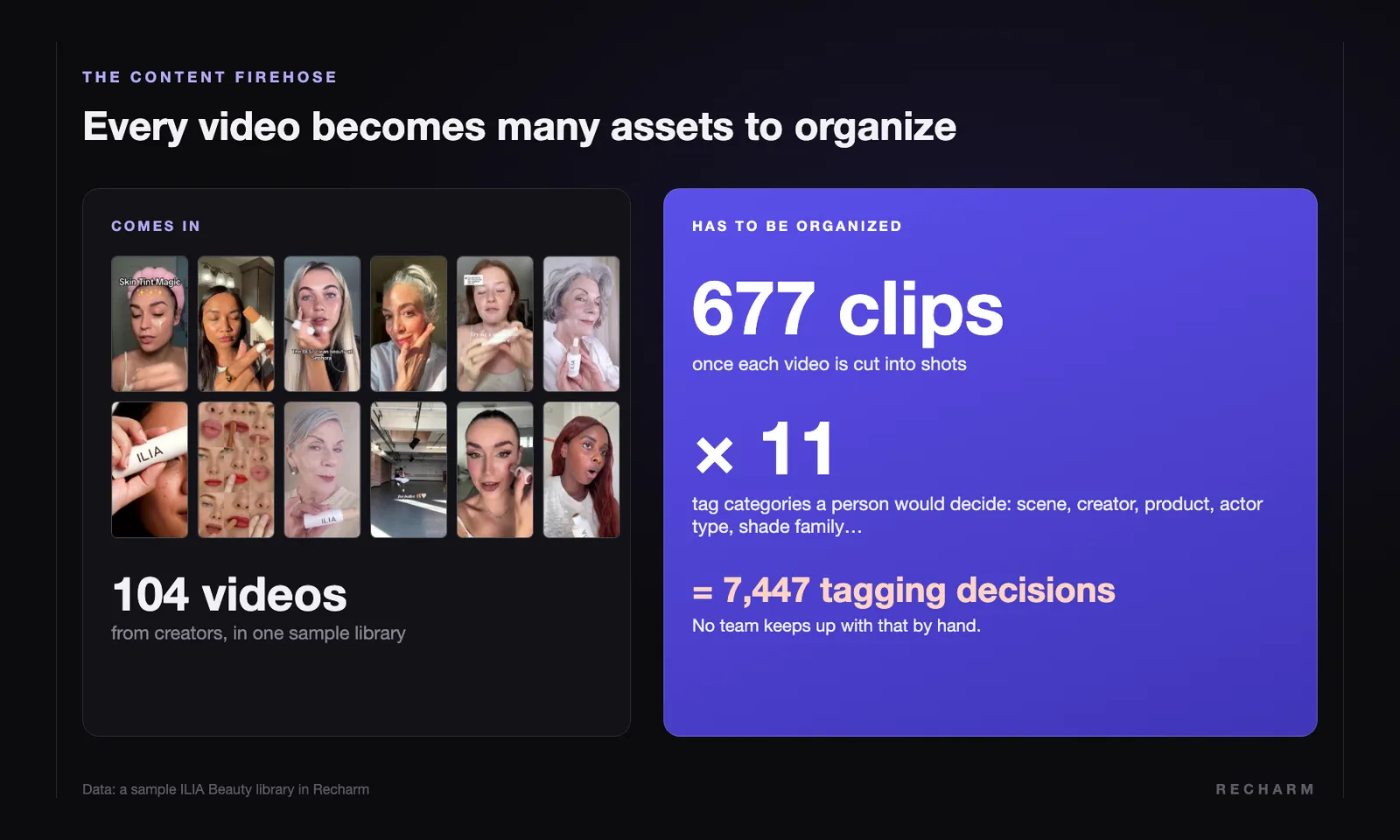
A team that keeps up today falls behind as soon as volume grows. And for creative teams, volume always grows.
Why More Rules Won't Fix a Failing DAM
Look at the seven reasons together and a pattern shows up. Every one is about people: what they're measured on, what they know, how much time they have.
A better folder structure won't fix that. Neither will a stricter naming convention or another training session, because each one still depends on people doing the organizing.
The way out is to stop making organization a human job. A DAM stays organized when something other than your team does the work. It has to never skip tagging on deadline day, apply the same rules to every asset and keep up with the firehose.
That's what AI is suited for, as long as it tags thoughtfully. Good AI video tagging breaks videos into shots and tags faces, products, on-screen text and ad angles. We cover the full standard in part two of this series: AI Tagging for DAM: 7 Things AI Should Do Without Being Asked.
It matters even more now that AI agents like Claude can brief and edit videos from your library. An agent can only use the footage it can find, so agentic video editing starts with an organized library.
Let AI Keep Your Library Organized
We built Recharm to make AI tagging on videos easy. It cuts every upload into clips, files each one by scene and makes footage searchable by what's on screen. HexClad's team now finds clips 83% faster.
FAQs
Why do DAMs get disorganized?
Because entropy in a DAM is high and grows with the size of the team. Creative teams are measured on output, not organization. Everyone has their own idea of organized, shared systems erode as people join and needs change, and the volume of content keeps growing.
What are the most common DAM challenges?
On the people side: no one is measured on organization, content managers have higher priorities, there's no shared system, systems are hard to maintain, teams work across time zones, rules can't be enforced and content volume keeps growing.
Can better rules keep a DAM organized?
Not for long. Rules, naming conventions and cleanup days depend on people following them, and they fade as soon as nobody is checking.
What should you do when your DAM can't find the right asset?
Look at how assets get tagged, not just how they're searched. If tags depend on people, search keeps failing as volume grows. Tagging at upload, cutting videos into clips and searching by what's on screen fixes the cause.
How do you fix a disorganized DAM?
Stop making organization a human job. Use AI to tag and organize assets as they come in, so the library stays consistent no matter who uploads what, when or from where.