
Every piece of creator content is owned by someone else until you have permission to use it. A customer tagging your brand or sharing a post with your hashtag does not give you the right to repurpose that photo or video in your ads. Using UGC without proper permission is a common source of copyright infringement claims, and brands can face takedown demands, statutory damages of up to $150,000 per work for willful infringement, and even ad account bans on platforms like Meta and TikTok.
This guide cuts through the confusion: what UGC usage rights are, why public social posts are not free for commercial use, how to obtain explicit creator consent, and how to track those rights at scale. This is an educational overview, not legal advice, so always consult qualified counsel for jurisdiction-specific rules.
TL;DR
UGC usage rights are licenses from creators, written permissions specifying how a brand can use their photos, videos, or posts for marketing, including where, how, and for how long.
Public does not mean free. A post being public, or a creator tagging your brand, does not transfer any rights. Copyright automatically stays with the creator, so written permission is required to repost or repurpose UGC.
Consent types matter. Implicit signals like likes, tags, or hashtag entries are not licenses. Only an explicit, scoped agreement counts, and it must clearly state the use case, duration, and channels permitted. Paid ads always require explicit written consent.
Scope of license is critical. A proper UGC license spells out usage length, platforms, edit permissions, territory, exclusivity, and fees. Without those specifics, the permission may not cover your intended use.
Track and renew rights. Usage rights expire. Brands should record each grant with start/end dates, allowed uses, and creator info. Modern DAM systems track UGC rights at the asset level to ensure expired content never runs.
Paperwork protects both parties. A clear license agreement protects your brand from infringement claims and ensures creators are compensated.
What Are UGC Usage Rights?
UGC usage rights are simply the legal permissions a brand obtains from a creator to use that creator’s content (photos, videos, reviews, etc.) for marketing purposes. Think of them as a license: the creator (copyright owner) grants your brand the rights to reproduce and display the content under specific conditions.
By default, the creator owns all rights to the content they produce. This includes TikTok videos, Instagram photos, testimonials, or unboxing clips. Copyright vests automatically with the creator as soon as the content is fixed in a medium.
Government guidance makes this clear: “Works published online, whether on a web page or on a social media platform, are generally protected by copyright… You generally need to obtain permission from the right owner before using it.” In short, if you didn’t create it, you need a license to use it.
A UGC usage license specifies exactly how you can use the content. Key scope details include:
Channels: Which platforms and formats? (e.g., brand website, Instagram feed, Facebook Ads, YouTube pre-roll, email newsletter, etc.)
Duration: How long you can use it (one month, six months, perpetual, etc.).
Edits: Whether you can crop, add effects, voiceover, or must use it “as is.”
Territory: Where (geographically) the content can be shown, if relevant.
Exclusivity: Whether the creator can also license it to other brands or not.
Usage type: Organic repost vs. paid advertising, print ads, or other specific uses.
Without a license covering each intended use, the brand can’t legally repurpose the content. For example, even if a creator says it’s okay to share their Instagram video on your feed, that alone does not allow you to run it as a paid TikTok ad. Each is a distinct use that must be in the license.
Why Are UGC Usage Rights Important for Brands?
Getting usage rights is not just a checkbox; it is critical for compliance and risk management.
Copyright infringement risk. Using UGC without permission is copyright infringement, and statutory damages for willful infringement run up to $150,000 per work under U.S. law. One viral video turned into an ad could trigger a six-figure penalty, and reposting multiple creator clips, especially with licensed music, can multiply liability across each underlying work.
Platform enforcement and ad bans. Meta, TikTok, and other ad platforms use automated systems to scan content for copyright issues. Brands that repeatedly run ads using unlicensed content risk having their ad account penalized or disabled. On TikTok, boosting another creator's video via Spark Ads still requires upfront permission, even when the platform technically allows the ad placement.
Reputational and relationship cost. Unauthorized use can tarnish your brand beyond legal fines. Creators who feel exploited may publicly call out the brand, leading to negative press and lost trust. Brands that respect UGC rights build goodwill instead, making creators more likely to collaborate again.
Creative compliance discipline. UGC rights management should be a process built into creative operations from the start, not a panic check before launch. A pre-flight rights checklist (written consent secured, disclosures present, music cleared) turns rights from a scary afterthought into just another workflow step.
Usage rights protect your brand on multiple fronts: legal, operational, and ethical. The safest approach is to treat every piece of creator content as owned by someone else until you have written permission that says otherwise.
Types of UGC Usage Rights and Consent Frameworks
Understanding different rights categories helps you know exactly what to ask for. Here are the main distinctions brands need to manage:
Types of Consent in Usage Rights
Understanding different rights categories helps you know exactly what to ask for. Here are the main distinctions brands need to manage.
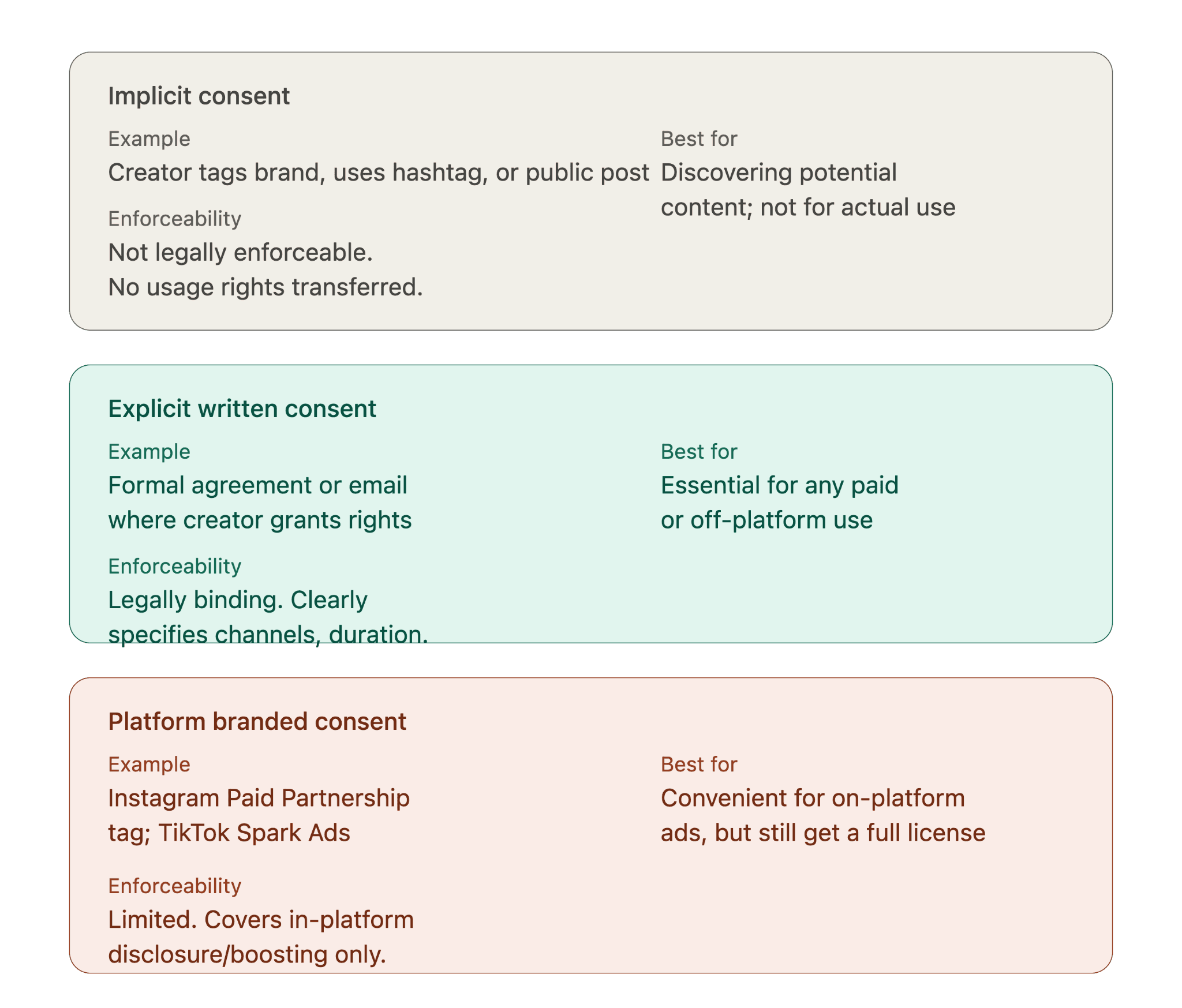
Implicit consent is not a license. Indirect signals like a creator tagging your brand, using your hashtag, or entering a contest show awareness of the brand, but they are not legal permission. A tag is a mention, not a transfer of rights, and participating in a branded challenge or making a post public does not grant commercial use rights. Implicit actions can alert you to good content, but explicit consent is still required before use.
Explicit written consent is the only bulletproof permission. This means the creator has directly agreed, usually in writing, to let you use their content under specified terms. It should be documented through an email or signed license form that clearly names the creator, the content, and the allowed uses, for example, "Brand may use this video in paid social ads on Facebook and Instagram through Dec 31, 2026." A simple email reply stating these details counts, but a DM or implied consent does not. Brands should never rely on assumed permission for paid campaigns.
Platform and branded content tools have limits. Instagram's Paid Partnership label or TikTok's Spark Ads require creator approval to boost a post, but these tools only track consent on-platform and do not replace a license. Even if a creator authorizes a branded partnership tag, you still need a proper license to use that content off-platform or in ads. These tools cover the act of amplification only; underlying copyright and likeness rights must be cleared separately.
Exclusive vs. Non-Exclusive Rights
Non-exclusive rights are the default for most UGC licenses. Your brand can use the content, but the creator retains the right to license it to others too. These deals are generally more affordable and common. A creator might grant your skincare brand non-exclusive rights to their video for 6 months while simultaneously licensing that same video to another beauty brand.
Exclusive rights mean only your brand may use the content as specified, and the creator cannot license the same usage to competitors for the duration. Exclusivity commands a premium, often 2-5x the cost of a non-exclusive license. Brands usually seek exclusivity only when it's crucial for a campaign, such as a hero testimonial they want sole ownership of. Carefully evaluate whether you actually need exclusivity, since it is harder and costlier to negotiate.

Organic vs. Paid Media Usage
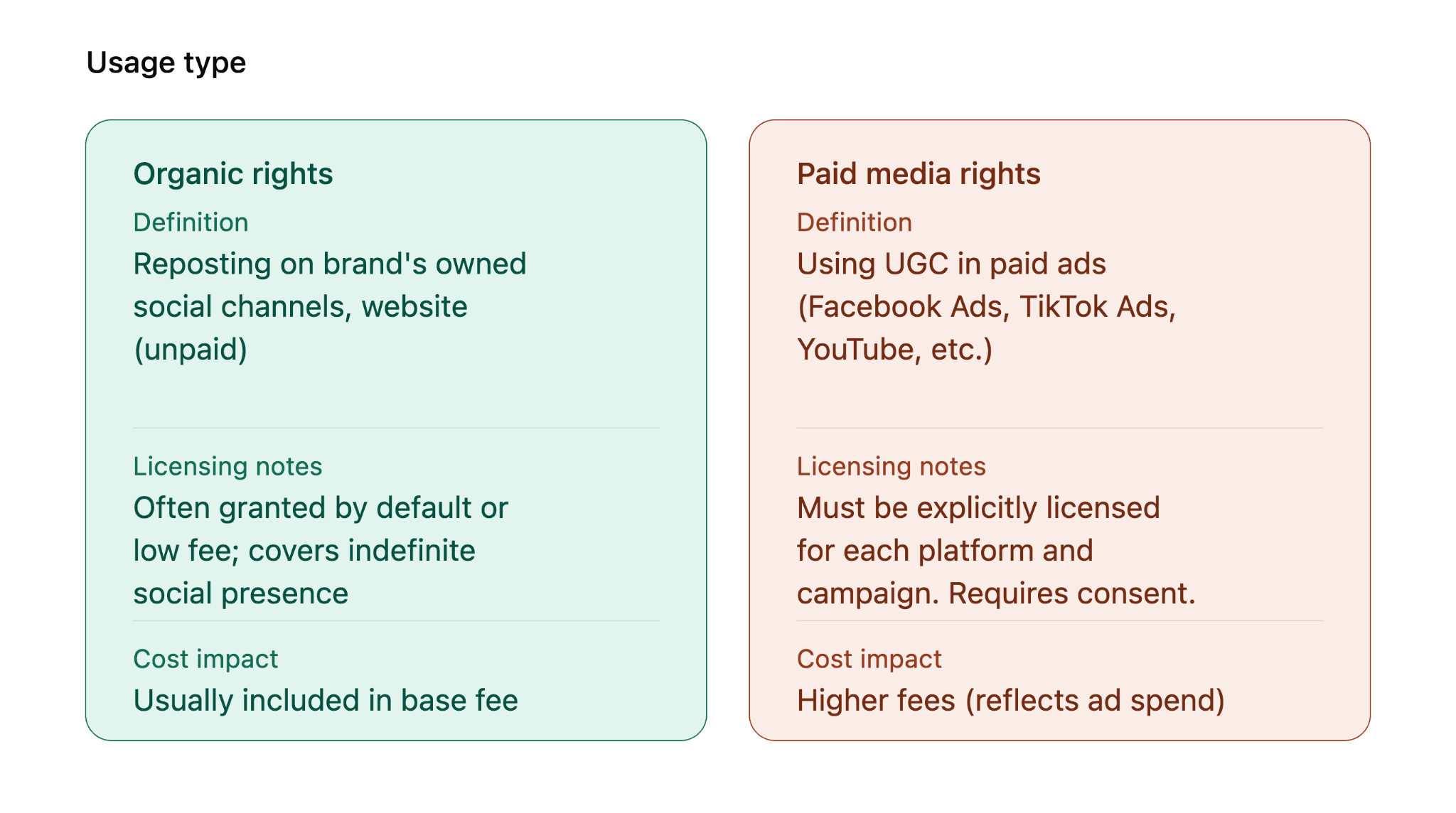
Organic usage covers posting UGC on your own social channels or website without paid promotion. Many creators grant free or low-cost organic use, often included in their base fee with no extra license needed. Organic rights typically have no strict time limit and stay up indefinitely once posted.
Paid media rights cover using UGC in advertisements or any paid placement, like boosting a post or running it in a TikTok campaign. This is a separate right that must be explicitly granted; a creator allowing organic reposting does not automatically cover paid ads. Because ads drive more value for the brand, paid rights usually come at extra cost and for a limited term of 1-3 months.
Defining Contract Scope: Timeframes, Costs, and IP Protection
Getting the rights themselves is only half the equation. The terms attached to those rights, how long they last, and what they cost, determine whether your license actually fits the campaign you're running.
How long should UGC rights last?
Common terms are 30 days, 90 days, 6 months, 12 months, or perpetual, depending on the campaign. Short-term (30-90 days) works well for seasonal content and is cheaper. Medium-term (6-12 months) is the practical default for most paid campaigns. Perpetual rights cost significantly more and are best reserved for content you know you'll reuse for years. Industry standard typically limits rights to 6-12 months, after which brands renegotiate or retire the content.
How much do UGC usage rights cost?
Fees vary widely by creator size, platform, and usage type, but here are general ranges. Organic social use is often included in the creator's base fee, especially for micro-influencers. Short-term paid ads (1-3 months) typically run $200-$600 per piece, often calculated as +20-30% of the base fee. Long-term paid licenses push fees higher: a 6-month license might run 25-40% of base, while perpetual rights can reach 100-150% of base, sometimes $500-$2,000 for lifetime rights to a high-performing video. Whitelisting (running ads from the creator's account) typically adds another 20-30% on top of the base fee. Exclusivity commands the highest premium at 2-5x the non-exclusive rate. Treat all of these as ranges to negotiate from, not fixed quotes.
How to Prevent Common UGC IP Issues
Even with usage rights secured, a few extra pitfalls can still trip up campaigns.
Music licensing is a common trap. If UGC includes copyrighted music, the platform's blanket license only covers organic plays; boosting that video with a licensed track requires a separate sync license. TikTok's Commercial Music Library only clears sounds inside the app, so always check the audio in your UGC and replace it with a licensed track before running ads.
Trademarked or branded content requires extra caution. If a UGC video shows a third-party brand or recognizable IP, you may need clearance from that rights holder separately, since the creator's permission alone is not enough.
Talent releases matter when UGC features a recognizable person beyond the creator, such as family members or bystanders. A talent or model release is separate from the usage rights license but equally important to avoid privacy or right-of-publicity claims.
Your license agreement should include a checklist confirming all music is cleared or replaced, no unauthorized third-party logos or people appear, and any necessary releases are obtained.
A Step-by-Step Guide to Acquiring UGC Usage Rights
Knowing the rules is one thing; actually securing rights from a creator is another. Here is the practical process to follow each time you want to use a piece of UGC.
Identify the content and creator. Determine which UGC assets you want, verify the creator's handle, and save a copy of the asset for reference.
Make a clear outreach request. Contact the creator directly and be specific about the exact content, your brand, the intended use (organic or paid), the channels involved, and the time period. Mention compensation upfront if applicable.
Document the agreement in writing. Get the creator's permission in writing before using the content, even a simple email reply stating the terms works. A DM or implied consent is not sufficient; only a documented license counts.
Log the rights immediately. Record the creator's name, asset ID or URL, usage type, start date, and expiration date in your asset management system. Tools like Recharm let you attach this metadata directly to the asset, turning word-of-mouth permission into tracked compliance.
Monitor and renew proactively. Set alerts for license expiration dates. Before a campaign ends, either renew the rights or remove the UGC from rotation. Teams often forget to retire assets and end up using them illegally months later, so an expiry alert system is essential.
What Every UGC License Should Include
A usage rights agreement (even an email) should clearly state:
Licensor/Licensee: Names of creator (licensor) and your brand (licensee).
Asset Description: URL or ID of the UGC piece.
Usage Rights Granted: Exactly which uses are allowed (e.g. “Use in paid social ads on Facebook, Instagram, and TikTok”).
Duration: Start and end dates of the license.
Geography: Territory, if relevant.
Exclusivity: Whether it’s exclusive or non-exclusive.
Fee/Compensation: Any payment terms or product exchange.
Modifications: If you may edit the content, or if it must remain unaltered.
Sign-off: An explicit statement of permission (“I agree to the above terms”) and date.
Having a checklist or template ensures you don’t forget a critical term. Agencies and legal teams often have standard UGC license forms – if you create your own, have it reviewed by counsel.
Best Practices for Managing UGC Rights
Securing a license is only the first step. Keeping rights organized and enforced over time is where most brands actually slip up.
Use template agreements. Develop a simple UGC license template tailored to your brand with all essential fields, and get it pre-approved by legal in each operating region to speed up deals and ensure consistency.
Include rights in creative briefs. When commissioning UGC, mention usage rights up front, for example, "by submitting the video, you grant us a non-exclusive, worldwide license to use it for 6 months." Building permissions into the brief is far cheaper and faster than renegotiating after the fact.
Centralize rights tracking. Do not let permissions live in inboxes or chats. A DAM or rights management platform that attaches creator, usage type, and expiry fields to each asset gives any team member instant visibility into whether content is cleared for use.
Stay FTC compliant. If you paid or compensated a creator in any way, including free product, the FTC requires disclosure of that material connection using labels like #ad or #sponsored, prominently placed.
Train your team. Make sure everyone from creative producers to media buyers understands the process: check consent, license form, and tracking record before approving any ad.
Run regular audits. Periodically review your UGC archive and flag content with missing or expired rights. Staying ahead of clearance prevents last-minute scrambles when a campaign is already live.
The Recharm Advantage: Bulletproof Creative Compliance and Asset Tracking
Managing UGC usage rights manually is a major reason brands slip up. Recharm is built to solve that exact problem by embedding compliance into your DAM and workflow:
Asset-Level Rights Data
In Recharm, every asset record can store its usage rights metadata. Instantly see which channels and dates are cleared. Before using any video or photo, a marketer can click into Recharm and confirm the permissions (this asset has a paid Facebook/TikTok rights valid through 12/2026, for example). This on-screen visibility puts rights in plain view.
Creator & Rights Linking
Recharm links each piece of content to the creator who made it, plus any license details or contract docs. Think of it as a “single source of truth” – no more digging through emails to recall who signed off. Your team always knows which creator gave permission and for what uses. This eliminates confusion (and the risk of reposting without consent).
Automated Expiry Alerts
Recharm can auto-notify you when usage rights are nearing expiration. That means no expired-asset faux pas. The system can even block expired assets from being exported into an ad platform or shared folder. In effect, it’s a built-in safety net that prevents “zombie” content from running after its license runs out.
Centralized Creative Compliance
By standardizing license templates and attaching them to assets, Recharm turns rights management into an operational process, not a legal headache. When you search for UGC assets, you also search their clearance status and content type. One team can oversee sourcing, another can oversee clearance, all within the same platform, preventing the “spreadsheet-and-email chaos” that typically causes rights violations.
In practice, using a tool like Recharm means UGC compliance is part of your publishing pipeline. When it’s time to launch an ad, your media buyer literally can see “Green = this clip is cleared for Instagram ads until Jan 2027” before hitting play. That peace of mind scales across hundreds of campaigns and creators, saving time and safeguarding your brand’s reputation.
FAQs
If a creator tags our brand in a social post, can we repost it or use it in ads?
No. A tag or hashtag mention does not grant any legal rights to use the content. Copyright remains with the creator, and you need explicit written permission before reposting or reusing UGC commercially.
What's the difference between organic and paid UGC rights?
Organic use means posting UGC on your owned channels without paying to promote it. Paid rights mean using the content in advertisements like Facebook, TikTok, or YouTube ads. These are separate permissions; a license allowing you to share something on your feed usually does not cover running it as an ad.
How much do UGC usage rights cost for a paid ad campaign?
Expect to pay significantly more for paid rights than organic use. As a ballpark, short-term paid ad licenses for a single video often run $300-$600, roughly double the organic rate, or priced as +20-50% of the base content fee. Whitelisting adds another ~20% of ad spend on top. Exact cost depends on creator tier, exclusivity, duration, and campaign reach.
What happens if a brand uses UGC without permission?
The brand risks legal and platform consequences. The creator can issue a takedown, demand licensing fees, or sue for copyright infringement, with statutory damages ranging from $750 to $30,000 per violation, up to $150,000 for willful cases. Platforms like Meta and TikTok may disable the ad or ban the account, and your brand's credibility with creators and consumers takes a hit as well.
How long should UGC usage rights last for a paid ad campaign?
It depends on the campaign. Time-limited promotions might license content for just 1-3 months, while many brands use 6-12 month licenses for longer campaigns. Always set an explicit end date, and if you need the content indefinitely, negotiate a perpetual license at a higher fee. Mark expiration dates in your system and renew proactively rather than assuming rights auto-renew.

