Most DTC brands struggle to bridge the gap between slick, agency-produced commercials and the unfiltered TikTok videos that users actually engage with. In practice, ads that feel native – shot by real people in real homes – consistently outperform polished productions on TikTok. In fact, TikTok reports that Spark Ads using creator videos saw 159% higher engagement than ads with non-creator content. Consumers trust these genuine voices: Nielsen found 92% of people trust UGC more than traditional ads.
This guide shows how to move beyond one-off videos and build a system for TikTok UGC ads. We cover why UGC-style ads win on TikTok, who to work with, how to brief and test creator content, and how to organize every clip so your creative library grows over time. You’ll learn to treat each creator submission as reusable ad fuel – scaling a content engine, not just churning out more videos.
What Is TikTok UGC?
TikTok UGC refers to short videos that look like organic creator content rather than scripted commercials. Whether brand-commissioned or not, UGC-style ads mimic TikTok's native format: vertical 9:16 video, candid tone, sound on. These are videos made by real people, whether influencers, customers, or employees, showing your product authentically instead of through a glossy studio shoot.
UGC vs. Branded Content in Plain Terms
A TikTok UGC ad feels like a friend's recommendation: casual, first-person, and often unscripted. A traditional branded video feels produced: voiceover narration, sweeping brand shots, polished graphics. Consumers notice the difference. Viewers are 3.1x more likely to call UGC "authentic" than brand ads, and Nielsen found 92% of people trust UGC over other content types. A casual testimonial from a fellow user carries far more social proof than a scripted commercial pitch.
Why TikTok User-Generated Content Converts
UGC ads inherit the behavior patterns of organic posts rather than triggering automatic skip behavior, which means higher watch times, better click-through, and lower costs. One brand switching to creator-made ads saw CTR jump from 0.6% to 1.9% (+217%) and CPA drop from $85 to $42 (-51%). TikTok data shows Spark Ads with creator videos drove 159% higher engagement than stock or agency ads at the same CPM, while UGC ads consistently deliver 30-50% lower CPAs across campaigns.
The conversion benefits follow the same logic. A CreatorIQ/TikTok study found 71% of viewers said a creator's authenticity led them to purchase after seeing a creator-driven ad. Unboxing videos generate +31% attention lift, and product-in-use videos drive +89% brand recall and +47% purchase intent lift. Seeing a real person use your product makes viewers remember and trust your brand far more than a logo ever could.
UGC also slashes production costs by 90%+ per video, letting teams test dozens of variants continuously instead of banking on one or two hero creatives. The brands winning on TikTok test multiple hooks, pitches, and videos every week, then scale only the winners.
Most Effective UGC Formats on TikTok
Certain content formats naturally fit TikTok’s style and drive conversions. High-performing UGC ads include:
Testimonials / Reviews: Real customers or influencers giving personal endorsements. A quick on-camera review of a beauty or fitness product, for example, builds trust and social proof. (TikTok research finds showing real users yields big lifts in attention and recall.)
How-To Tutorials: “Watch me use this product” style demos. Showing step-by-step use (say, a gadget or recipe) educates the viewer while subtly selling the result. These combine “problem-solution” narrative with genuine utility.
Before/After Storytimes: Creators narrate a problem that was solved by the product. For instance, “I struggled with dry skin until I tried this cream – now my skin is glowing.” This format taps emotions and narrative, hooking viewers in a story.
Unboxing / First Impressions: The creator films opening the package and reacting live. TikTok found unboxings get about +31% attention lift. Quick surprises (like revealing the product) make good hooks.
Day-in-the-Life: POV clips showing how the product fits into an everyday routine. For example, “morning routine” videos featuring your skincare or coffee maker can feel organic and relatable.
Problem-Solution / Hacks: Creators frame a common problem (“Tired of flimsy chargers?”) and immediately present the product as the solution. This direct hook can snag attention right away.
By weaving products into these narrative or tutorial formats, creators make ads feel like tips or stories – content that TikTok users actually want to watch.
Leveraging TikTok Engagement Features
Duets and Stitches are two of TikTok's most underused UGC multipliers. With Duet, a creator records side-by-side with another video, such as reacting to a viral unboxing or revealing a before-and-after in split-screen. With Stitch, a creator clips a snippet of an existing video and adds their own response. A brand video asking "What's the best way to pack for travel?" can invite users to stitch with their own tips featuring your product.
Launching a challenge that asks fans to Duet or Stitch a seed video can generate dozens of authentic replies with your branded hashtag, each one becoming new ad fuel at a fraction of the cost of contracting individual creators. Frame a clear prompt, make the visual seed easy to latch onto, and reward the best responses.
How to Source and Order TikTok UGC Ads
1. Define your audience and offer. Before contacting anyone, clarify who the content should speak to and what action it must drive. Are you targeting budget-conscious moms, Gen Z gamers, or fitness enthusiasts? Spell out the core message: the specific pain point, product benefit, or story angle. This ensures creators produce videos that actually match your campaign goals.
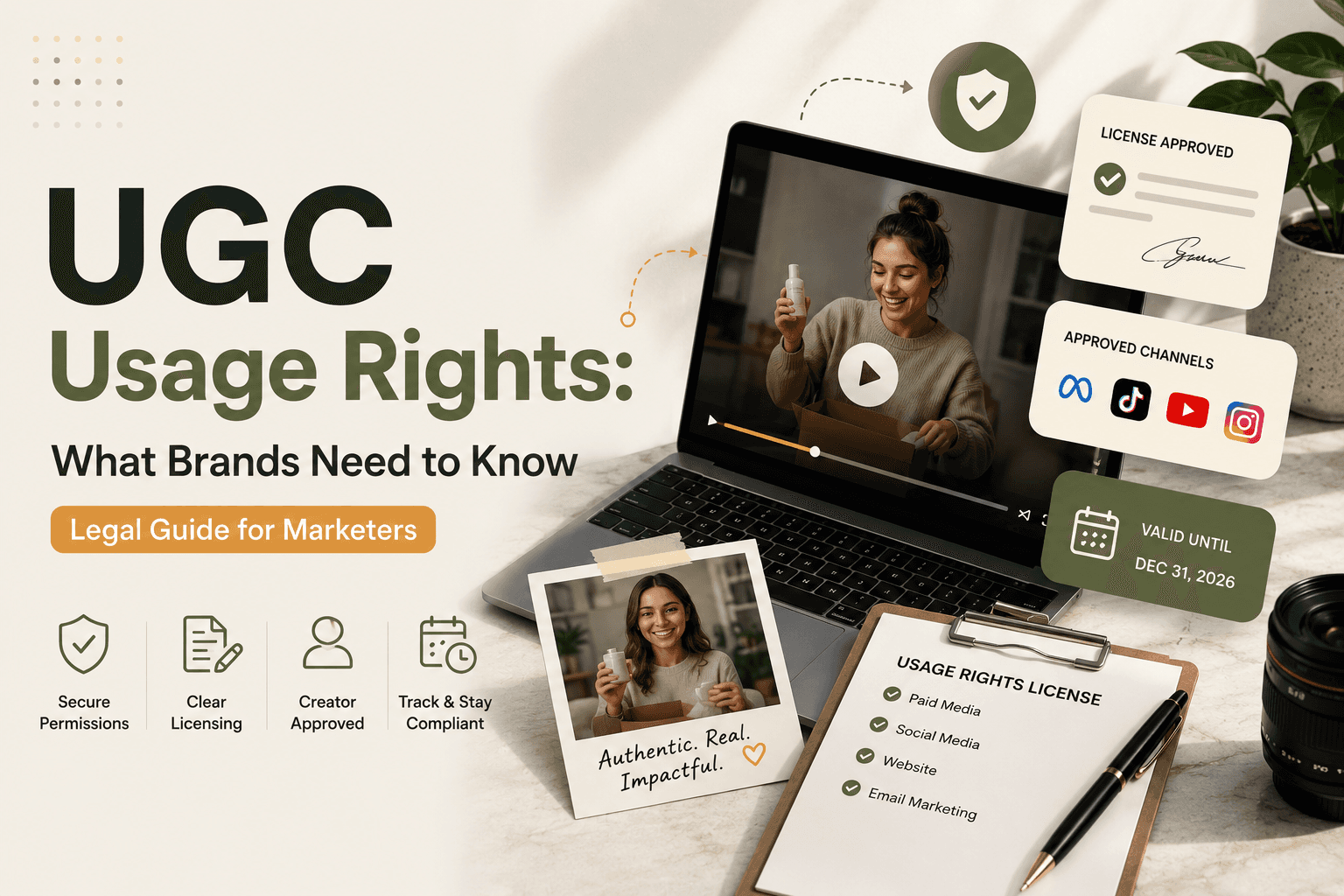
2. Shortlist and brief creators. Use TikTok's Creator Marketplace or specialized UGC platforms to find candidates who match your niche, checking follower demographics, engagement rates, and content style. Once shortlisted, brief them precisely: campaign theme, target audience, key selling points, required CTA, tone examples, and platform specs. Outline usage rights upfront, especially if you plan to run Spark Ads from their account. TikTok's Content Suite even lets you send a one-click Spark Ad authorization request. Get deadlines, deliverables, and compensation agreed in writing before filming starts.
Creator brief checklist:
Target audience and campaign goal
Hook or opening scenario
Product features or benefits to highlight
Desired format (testimonial, demo) and tone
Examples of successful hooks or UGC
Platform specs (9:16, sound on) and disclosure requirements
Deadlines, deliverables, and usage/licensing terms
3. Test Before Scaling. Start with 3-5 UGC videos per ad group, as TikTok recommends, with diverse hooks and approaches. Measure hook rate (viewers past 3-6 seconds), CTR, and conversion. Double down on clips with strong CTR and lower CPA; pause underperformers. Finding out a concept flops on a $500 test is far better than a $5,000 one.
Before filming checklist:
Confirm product shipment to creators
Share brand assets (logo files, approved overlays)
Agree on shoot environment and lighting
Remind creators to keep audio natural
Reiterate disclosure rules (#ad if paid)
Confirm usage and licensing agreement is signed
Creator Marketplace | Direct Outreach |
Curated platform with search filters and verified profiles | Manual DM or email; more personal but less scalable |
Access to performance stats and matched suggestions | Must vet creator metrics yourself |
Slightly higher fees but streamlined contracts | No marketplace fees but more negotiation hassle |
Lower risk of scams or bots | Higher risk if creator is unknown |
Easy Spark Ad permission requests at scale | Must track ad permissions individually |
TikTok Strategies for Scaling Creative Output
Once you know what works, ramping up volume without burning out your team requires a system, not just more effort.
Branded hashtag challenges. Launch a Branded Hashtag Challenge, inviting your audience to create content around a theme featuring your product. TikTok reports these achieve around 17.5% median engagement, and a well-run challenge can yield hundreds of organic videos, with one case study showing half the ROI coming from post-campaign earned views alone.
Referral rewards for creators. Offer a bonus (cash or product) when a creator refers someone who produces a video. Friends and acquaintances of existing creators tend to match your content vibe naturally, expanding your pool without starting from scratch.
Remix campaigns. Launch a recurring Duet or Stitch prompt from your brand account and invite TikTokers to react. Each remix becomes new UGC, and highlighting the best ones drives even more participation. It is essentially a self-sustaining content loop.
Hook-first iteration. TikTok data shows 90% of an ad's recall impact occurs in the first 6 seconds. Test variations of just the opening moment: a question on screen, a surprising visual, or a direct-to-camera problem statement. Measure hook rate (percentage watching past 3 seconds) separately from CTR, and double down on whatever stops the scroll best.
Continuous A/B testing. Run 3-5 creatives per ad group with meaningful differences between them. When performance drops, refresh the existing ad group with new videos rather than creating a new one. This preserves audience data while keeping the creative learning going.
Creative fatigue management. Maintain a library of at least 10-20 active clips per campaign, mixing angles and hooks. Once a video's CTR or view rate falls off, retire it or remix it. The rule is simple: rotate before fatigue sets in, not after.
Scaling Tactic | How It Helps |
Branded Hashtag Challenges | Mobilizes hundreds of fans to create content organically |
Referral Rewards | Each creator recruits new talent, amplifying content supply |
Duet/Stitch Remixes | Leverage trends and community content for endless new angles |
Hook-First Iteration | Optimizes first 6 seconds (90% of recall) for max retention |
Continuous A/B Testing | Rotate 3-5 creatives per group to identify winners quickly |
Regular Creative Refresh | Swap in new UGC ads before old ones fatigue |
Streamlining Your Workflow with Recharm
Managing UGC at scale is where most teams hit a wall. Hours disappear scrubbing footage, chasing permissions, or hunting for a clip that definitely exists somewhere. Studies show companies typically use only ~5% of the footage they shoot, with the rest sitting unused because it is too hard to find.
Recharm fixes this by acting as a centralized video asset management platform where every UGC clip is ingested, tagged, and indexed the moment it is uploaded. Your entire library becomes searchable by what is actually inside the footage, not just file names.
AI-powered visual search. Type "woman unboxing product" or "man smiling at camera" and Recharm surfaces matching clips across your entire library, jumping straight to the exact timestamp. A strategist can pull footage for a brief in seconds, and an editor can preview and download only what they need without opening a single full file.
Automated context tagging. Every video is labeled at upload with information about who is in it, the shot type, on-screen products, emotions, and logos. Your library becomes instantly filterable by creator, product, content angle, or demographic. Strategists find all "before/after testimonials" in one click, and editors spend their time cutting rather than searching.
Stop Chasing Creators. Start Building a System.
Winning on TikTok is not about one great ad. It is about building a system where every creator's video becomes a reusable asset in a growing library. That means equal focus on sourcing, briefing, testing, and organizing: find the right creators, brief them for proven hooks and formats, test variations, and tag every clip you receive.
Today's videos teach you what resonates. Tomorrow's creators start from a higher baseline. When your team uses AI tagging, visual search, and structured creative checklists to manage volume, dozens of random videos become a high-performance ad library that compounds over time, scaling output without ever outpacing your team's capacity.
FAQs
What makes a TikTok UGC ad different from a regular branded ad?
A TikTok UGC ad looks and feels like organic user content, shot by a real person in an authentic setting rather than a polished studio. Nielsen reports 92% of people trust UGC over other content types, and Spark Ads with creator content show 159% higher engagement than non-creator ads. A UGC ad feels like peer content; a branded ad feels like an ad.
How much should I pay creators for TikTok UGC content?
Raw UGC clips from newer creators typically run $75-$200 per video, while more experienced creators charge $200-$500. Fully edited, ad-ready videos range from $150-$400 for rising creators and $400-$1,000+ for top-tier specialists. Spark Ad rights (running the ad from the creator's handle) typically add 25-50% on top of the base rate.
Do I need usage rights agreements for TikTok UGC ads?
Always. For Spark Ads, you need the creator to authorize the boost through TikTok's Content Suite one-click Brand Deals request. For in-feed ads using supplied footage, you need a written agreement covering the specific platforms and permitted uses. Verbal permission is not sufficient.
How many UGC ad variations should I test at once?
TikTok recommends 3-5 creatives per ad group, each with a meaningfully different hook, thumbnail, or concept. This balances variety with budget efficiency. Measure view rates, CTR, and conversions, then keep top performers and replace underperformers.
Can UGC content be repurposed for Meta or YouTube Shorts?
Yes. The same raw footage can serve TikTok, Instagram Reels, YouTube Shorts, and Facebook ads with platform-specific edits to aspect ratio, length, and audio. The core stories and shots translate well across short-video channels.