
Creative Strategist is a new and emerging role in a marketing team. A person becomes a creative strategist with experience. One doesn’t go to college to get a degree in creative strategy. Individuals graduate into these roles. Some are performance marketers with a creative bent, and some are creative designers with an analytical mind. Some are great brand marketers with clarity of value, product, and customers.
Only a few in marketing have worked as creative strategists or hired one. Therefore, it is sometimes unclear how to interview a creative strategist.
Hiring a creative strategist is different from hiring a copywriter, media buyer, or designer. The role sits at the intersection of creativity, performance marketing, customer research, and experimentation. The best candidates don't just generate ideas—they build systems for testing, learning, and improving creative performance. That's why asking the right interview questions matters.
Here are 12 interview questions you can ask when hiring a creative strategist for your creative team.
TL;DR
Creative strategists combine creativity, marketing, research, and analytics.
Look beyond generic answers—ask for real examples and measurable results.
Evaluate how candidates think, not just what they know.
Test their understanding of performance metrics, creative testing, AI, and customer research.
The strongest candidates connect creative decisions with business outcomes.
What Does a Creative Strategist Actually Do?
Creative strategists bridge the gap between marketing strategy and creative execution. They research customers, identify messaging opportunities, develop creative hypotheses, and work with designers, editors, copywriters, and media buyers to launch and improve campaigns.
Typical responsibilities include:
Customer research
Creative briefing
Script writing
Ad concept development
Creative testing
Performance analysis
Iteration planning
Competitive research
Unlike traditional marketers, creative strategists continually test ideas and use performance data to determine which creative elements to produce next.
Skills Every Great Creative Strategist Should Have
When hiring a creative strategist, look for a combination of creative instincts and analytical thinking.
Skill | Why It Matters |
Customer Research | Finds real customer pain points |
Copywriting | Turns research into compelling messaging |
Creative Briefing | Helps creators execute consistently |
Performance Marketing | Understands CTR, CPA, Hook Rate, ROAS |
Data Analysis | Learns from winning and losing creatives |
Experimentation | Builds hypotheses instead of guessing |
Communication | Aligns media buyers, creators, and designers |
AI Tools | Speeds up research and creative production |
1. Define what a creative strategist does.
Look for clarity in their idea of a creative strategist’s role. Look for substantiation of that clarity with specific examples.
Everyone’s perspective on creative strategy is different. There is no definition of creative strategy, after all. A candidate’s description of creative strategy should match (or inform) your definition of creative strategy.
Best creative strategists will elevate your understanding of what a creative strategist can do.
2. What qualities make a creative strategist successful?
Look for specificity.
It is very easy to rattle off a list but hard to give personal examples. You are looking for a diverse set of skills -- creativity, process, familiarity with data, collaboration, etc.
Essential qualities to look for:
Communication skills – Can they explain complex concepts in simple terms?
Focus on understanding the customer – Do they know how and why strategists need to understand the customer deeply?
Experimentation mindset – Can they translate any idea into an experiment?
The mix of creative and analytical skills.
Detailed oriented
The answer to this question requires specificity. An average candidate would rattle off a list of generic qualities. Great candidates cite examples.
3. How involved are you with ad account metrics (CPA, CTR, Hook Rate)?
The "Creator" Filter: If they only talk about "vibes" and can't connect a concept to a Hold Rate, they are a content creator, not a strategist. They must be comfortable inside the ad account.
Good follow-up questions:
Which metric do you look at first when a creative underperforms?
Tell me about a time CTR was high but CPA stayed poor.
How do Hook Rate and Hold Rate influence creative decisions?
What metrics tell you a creative is fatiguing?
These follow-ups help separate someone who has managed campaigns from someone who has only observed them.
4. What is the most important part of being creative strategist?
Look for the "why."
This is a “why” question disguised as “what.” Why is a creative strategist’s role important? What impact can it have? How can a creative strategist fail? Without explaining the “why,” the answer to this question is not complete.
Through this question, you can dig deeper into the candidate’s record as a creative strategist. You can ask about the specific impact they have had in the past, either as a creative strategist or in a role that qualifies them to be one.
5. What trends have you seen in the DTC regarding ad creatives?
Look for curiosity. You want a person who is hungry to learn and will bring in new ideas continuously.
Knowing trends is less important than having a process to spot trends. How much time do they spend on social media? Have they utilized trends in social media before? Do they create content that rides trends? Who do they learn from and follow to be in the know about DTC direct response advertising?
Only some people can be on top of trends all the time. Only a curious person will find an inner passion for keeping up with this arduous task.
Ask them to explain:
One recent Meta trend
One TikTok creative trend
One creator-led advertising trend
One AI trend changing creative production
You're testing whether they actively study the industry or simply consume social media.
6. Scroll through your Instagram/TikTok feed right now. What do you see?
Consumption habits dictate creative instincts. A strategist’s feed is usually a mix of competitors, direct-response ads, and niche interests they are "mining" for inspiration.
7. What does your creative ideation process look like?
Look for examples, and avoid falling for abstraction.
It is very easy to talk about a process as a professor and in abstraction. Not easy to talk about a process with a specific example.
The ideal candidate should clearly articulate their creative ideation process with examples. Creative strategists lead the creative ideation process and decide on what creative to run next. Therefore, you are looking for a structured thinker who can break down complex ideas into simple executable experiments designed to maximize learning and find winning creatives.
Things to look for:
Can they lead brainstorming sessions?
Can they get everyone in the room to contribute?
Can they effectively organize information?
Can they apply past creative performance data to establish priority?
Can they help frame experiments in hypotheses?
Can they make decisions and get the team to execute those decisions?
8. Where do you go to find creative inspiration for ads?
Look for depth.
Very easy to cite all the usual places to find inspiration. Depth is when a creative strategist can cite specific inspiration from specific brands. For example – I love Masterclass ads because they have fast cuts and powerful background music. It creates engagement.
Creative strategists should cite examples of top creatives they have seen and why they were so great. Inspiration stimulates the growth and evolution of an idea, so it is important to know where the candidate looks for it.
An ideal candidate can critique creatives by applying high-level frameworks to gain a deeper understanding. For example – understand a creative from the lens of content pillars. Is it entertainment, educational, or aspirational? Do they cite how creatives speak to customers psychologically?
9. How would you define “variations,” and what changes would you make in a creative for variation?
Look for why, what, and how.
Use this question to judge the seniority and experience of the person. This question brings marketing, data, and creativity — all three together.
Why use variations – An ideal candidate can tell you why variations are important in the iterative process. This one should be easy.
What types of variations – An ideal candidate tells how to use data to inform the kinds of variations to make. Should there be variations on the hook, content copy, music, or something else?
How to make variations – An ideal candidate works with a designer or video editor to specify what changes need to be made. Look for a detailed orientation of the candidate.
10. Can you give an example of how you've adapted an ad concept cross-platform?
Look for execution.
This is where the theory of creative strategy meets the hard reality of multiple ad platforms. Someone who has experience knows this well and can speak to it.
An ideal candidate has adapted an ad concept cross-platform and driven higher conversion. Even more important is understanding what works on different platforms and whether to repurpose a creative on other platforms. If the candidate demonstrates a nuanced understanding of what works on various platforms is a strong indication of experience and knowledge and will be a crucial indicator of success.
11. What script-writing formulas have you used successfully in the past?
Look for the craft.
Building creatives is an art. You need to understand direct-response advertising and marketing concepts.
Candidates can take this question as deep as they want. Deeper they go, the more craft they show.
Ideal candidates clearly articulate the anatomy of an ad (hook, features, and CTA) and ad building blocks. They demonstrate insights into the script-writing formulas and their understanding of key performance metrics. They will repeatedly cite how vital the hook is in any video creative.
12. What AI tools are you using for research and ideation?
Look for practical workflows, not tool lists.
In 2026, AI is no longer a bonus skill for creative strategists—it’s a productivity multiplier. If a candidate isn’t using AI at all, they’re likely slower than the market. If they rely on AI for every idea, they’re outsourcing judgment. The strongest candidates use a human-in-the-loop workflow: AI helps them process large amounts of information quickly, but they make the final creative decisions themselves.
A great answer sounds like: “I use AI to analyze 1,000 Amazon reviews and surface recurring pain points, then I write the hook and angle myself.” That shows speed and taste.
Look for candidates who use AI to:
Analyze Amazon reviews for customer pain points
Summarize Reddit discussions and community language
Cluster objections and motivations into clear themes
Generate multiple creative angles for testing
Rewrite and iterate on hooks and openings
Research competitors and ad trends
Organize swipe files and winning creative references
Analyze patterns across high-performing ads
The goal isn’t to find someone who knows every AI tool. It’s to find someone who has built a repeatable research and ideation workflow that turns customer data into better creative hypotheses faster.
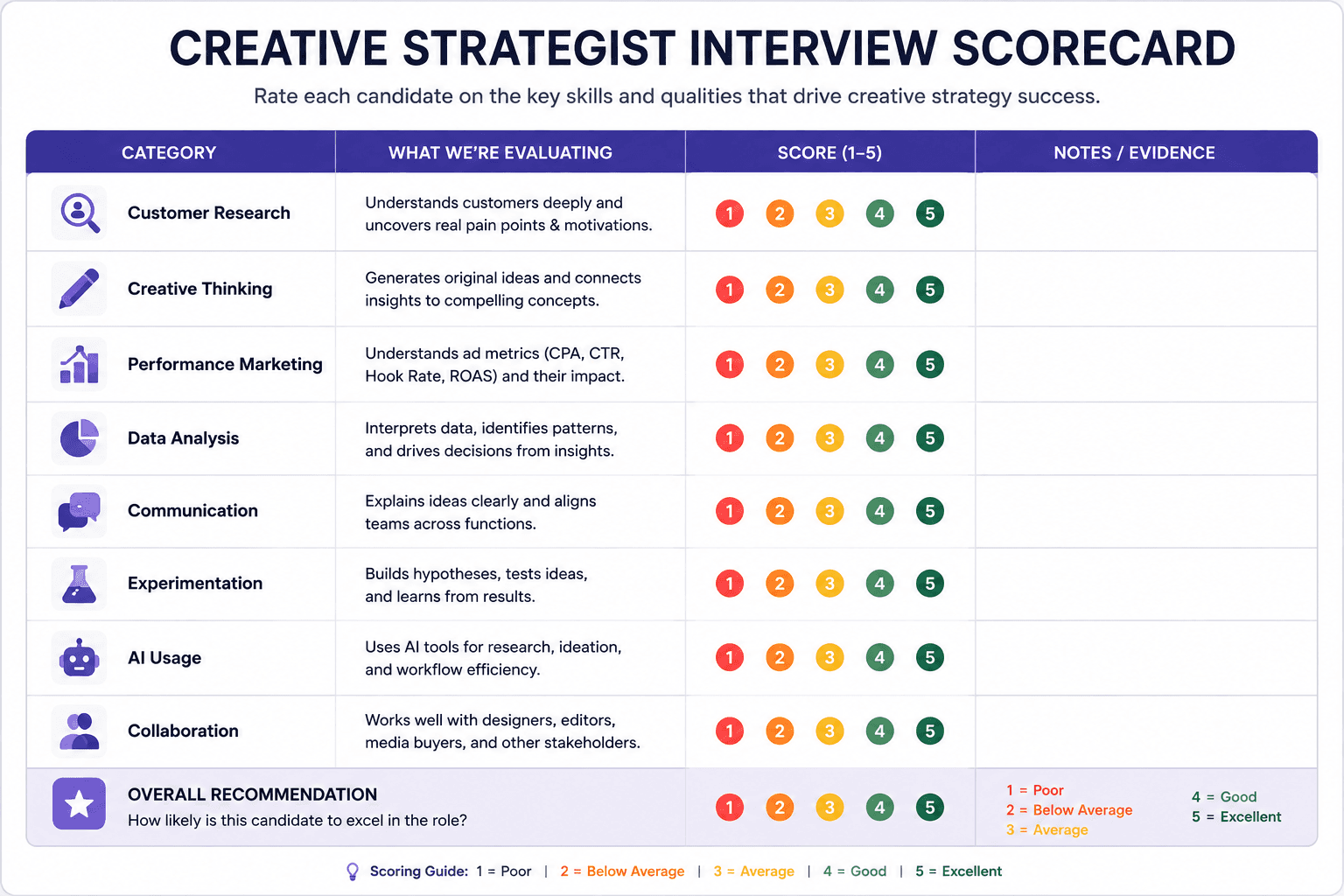
To make interview decisions more consistent, use a simple scorecard instead of relying on gut feel after the conversation.
Red Flags to Watch During the Interview
Not every strong communicator is a strong creative strategist. Watch for warning signs like:
Only talks about "branding" without discussing testing.
Cannot explain campaign metrics.
Has never worked with media buyers.
Gives generic answers without examples.
Relies entirely on AI for ideation.
Doesn't mention customer research.
Can't explain why previous ads succeeded.
Doesn't ask questions about your customers or product.
These often indicate someone who understands marketing theory but lacks hands-on experience.
How Recharm Helps Creative Strategists
Creative strategists spend surprisingly little time coming up with ideas. Much of their week goes into finding old ads, reviewing performance, collecting inspiration, writing briefs, and coordinating with editors.
As creative libraries grow, that work becomes harder. Winning ads get buried in folders, feedback is scattered across different tools, and teams often recreate ideas because they can't find previous winners.
Recharm helps solve that operational challenge by organizing every creative asset in one searchable library. Teams can quickly find winning ads, group creatives by campaign or concept, review past performance, and reuse successful ideas without starting from scratch.
Instead of spending hours searching for assets, creative strategists can spend more time researching customers, developing stronger hypotheses, and testing new creative ideas.
Hire Strategists Who Can Scale Creative, Not Just Create It
The best creative strategists are more than idea generators—they build repeatable systems for finding, testing, and improving winning ads.
These interview questions help you look beyond confidence and presentation skills. They reveal how candidates think, how they use data, how they learn from customers, and whether they can turn creative ideas into measurable business results.
The strongest hires combine curiosity, structured thinking, experimentation, and execution. Those are the people who help creative teams produce better ads consistently, not just occasionally.
FAQs
What experience should a creative strategist have?
There is no single career path. Many creative strategists come from performance marketing, copywriting, media buying, content creation, or video production. The strongest candidates understand both creative storytelling and performance metrics.
How do you evaluate a creative strategist during an interview?
Ask candidates to explain real campaigns they've worked on. Look for how they researched customers, developed hypotheses, measured success, and improved creatives based on performance data rather than opinions.
Should a creative strategist understand ad metrics?
Yes. A creative strategist should be comfortable discussing metrics like CTR, CPA, Hook Rate, Hold Rate, ROAS, and creative fatigue. These metrics help determine which ideas should be scaled, iterated, or discontinued.
What AI tools should creative strategists know?
Modern creative strategists should use AI to speed up research, analyze customer reviews, brainstorm concepts, summarize competitor ads, and organize creative workflows. However, strong creative judgment should always remain human-led.
What's the difference between a content creator and a creative strategist?
A content creator focuses on producing content. A creative strategist focuses on deciding what content should be created, why it should work, how it should be tested, and how future iterations should be improved based on performance data.