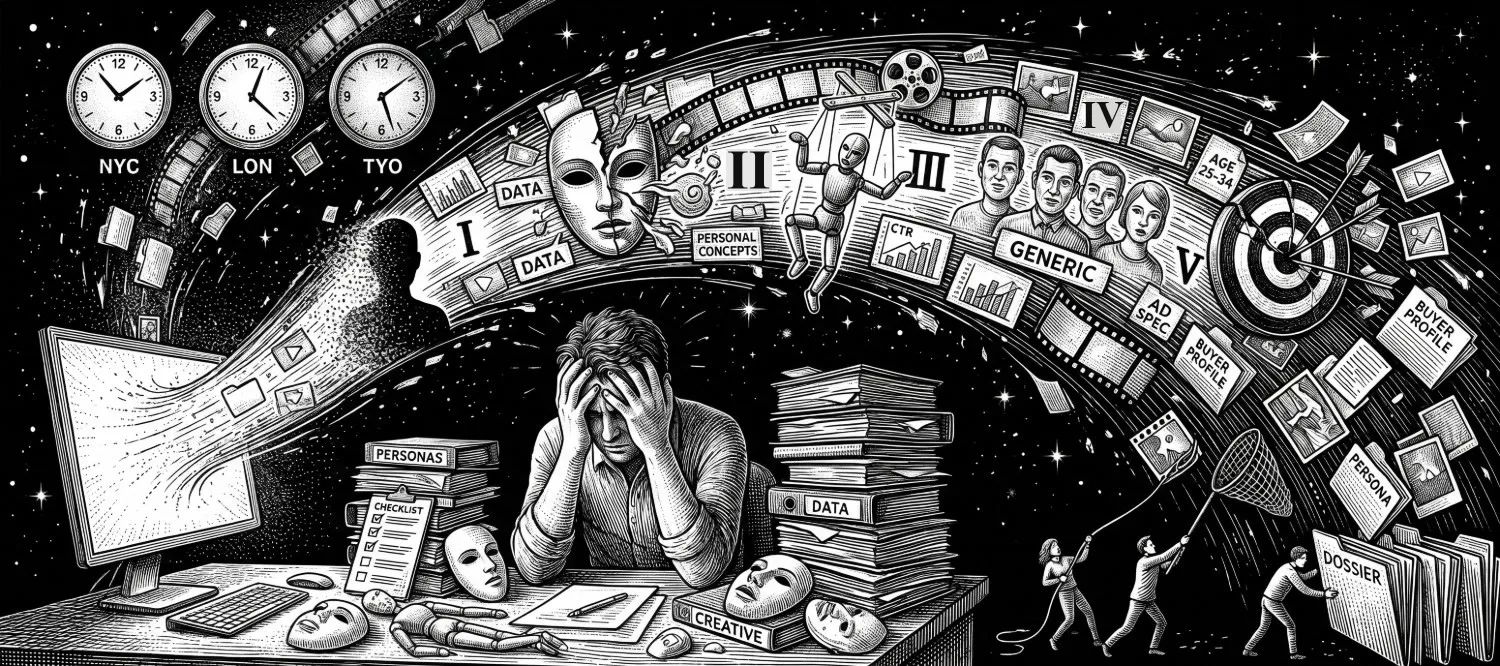
Every brand has a persona deck. It has names, stock photos, and a few bullet points on motivations and pain points. It was probably made for a rebrand or a launch, and it probably hasn't been opened since.
Meanwhile, the ad account keeps telling a different story about who is buying and why.
After spending a lot of time with creative teams, here is what I have come to believe about personas in performance creative, and why the person who understands them best is rarely the person who wrote them.
TL;DR
- Personas are written at a point in time, but the customers they describe keep changing.
- Product, brand and performance creative each have their own personas, and they change at different speeds.
- Some personas are defined, some are discovered in reviews and customer videos, and some start as experiments.
- Reconciling them never ends, and creative strategists hold the most current picture.
- That picture is only valuable if they share it with the rest of the company.
1. Personas are static documents describing moving targets
A persona is written at a point in time. The customer it describes keeps changing.
Refreshes tend to happen at distinct moments: a rebrand, a new product line, a new marketing leader. Between those moments, years can pass. The deck stays frozen while the audience moves, new use cases appear, and old motivations fade.
Nobody decides to let personas go stale. It just happens, because updating them is nobody's daily job.
2. There is more than one set
We talk about "our personas" as if there is a single list. There isn't. Product, brand, and performance creative each have their own, built for different purposes.
Take a hypothetical online eyewear brand selling prescription glasses:
| Product persona | Brand persona | Performance creative personas | |
|---|---|---|---|
| Example | The all-day screen worker | The design-conscious professional | Sticker-shocked shopper, reluctant first-timer, backup-pair parent, headache sufferer, weekend-pair contact lens wearer |
| Built around | Needs and use cases | Identity and positioning | The moment or trigger that makes someone buy |
| Shapes | Frame weight, lens options, try-on experience | Site design, tone of voice, photography | Hooks, scripts, ad concepts |
| How many | A few | One or two | Many, with subgroups |
| Pace of change | Years | Slowly | Months |
These sets ladder up and align. The sticker-shocked shopper and the headache sufferer could both be the all-day screen worker. But they are not the same thing, and they do not evolve at the same pace. Treating all three as one document is where a lot of confusion starts.
3. Some personas are defined, and others are discovered
There are personas you deliberately define and iterate toward. Then there are personas that show up on their own.
Your product reviews, customer videos, and feedback are full of the second kind. Read enough of them and you find people using the product in ways, and for reasons, nobody planned for. Mining this material can feel like a cheat code, because customers are describing themselves in their own words.
But the two kinds are different, and it matters which one you are looking at. A defined persona reflects where the brand wants to go. A discovered persona reflects where customers already are. Neither one is the full truth by itself.
4. Some personas have to be experiments
A third kind is neither handed down nor discovered. It is invented.
Brand marketing won't give you these. Product won't either. Creative strategists come up with them as hypotheses: what if we spoke to this kind of person, with this angle? Then they build concepts around the idea and let the results answer.
Most of these experiments fail, and that is fine. The ones that work become emerging personas that the rest of the company doesn't know about yet.
5. Reconciliation never ends
So at any given moment a brand has defined personas, discovered personas, and experimental personas, spread across product, brand, and performance, all changing at different speeds.
They will never sit in neat, pre-defined boxes. Reconciling them is a non-stop game.
Great creative strategists play that game in their heads every day. They know which personas are holding up, which are evolving, and which are just starting to emerge. That live picture exists almost nowhere else in the company.
What this means for the creative strategist's role
If that knowledge stays in one person's head, most of its value is lost.
Communicating the current state of performance creative personas, how they are changing, and which new ones are emerging is a critical part of the job. Media buyers make better decisions with it. Designers and video editors make better ads with it. Brand marketing and product teams could learn a lot from it too, if they were listening.
Creative strategists are the eyes and ears of a brand. They see how customers perceive and use the product through real reviews, real footage, and real ad results, refreshed constantly. On that question, they can do a much better job than the product and brand teams who wrote the original personas.
The deck shows who you thought your customer was. Your creative strategist can tell you who they are today.