
Most teams launch a video ad, watch it underperform, and move on. They blame the concept, brief a new one, and repeat the cycle. The problem was never the concept. It was the first three seconds.
Hook iterations are how you fix that without starting over.

What Are Hook Iterations and Why Do They Matter?
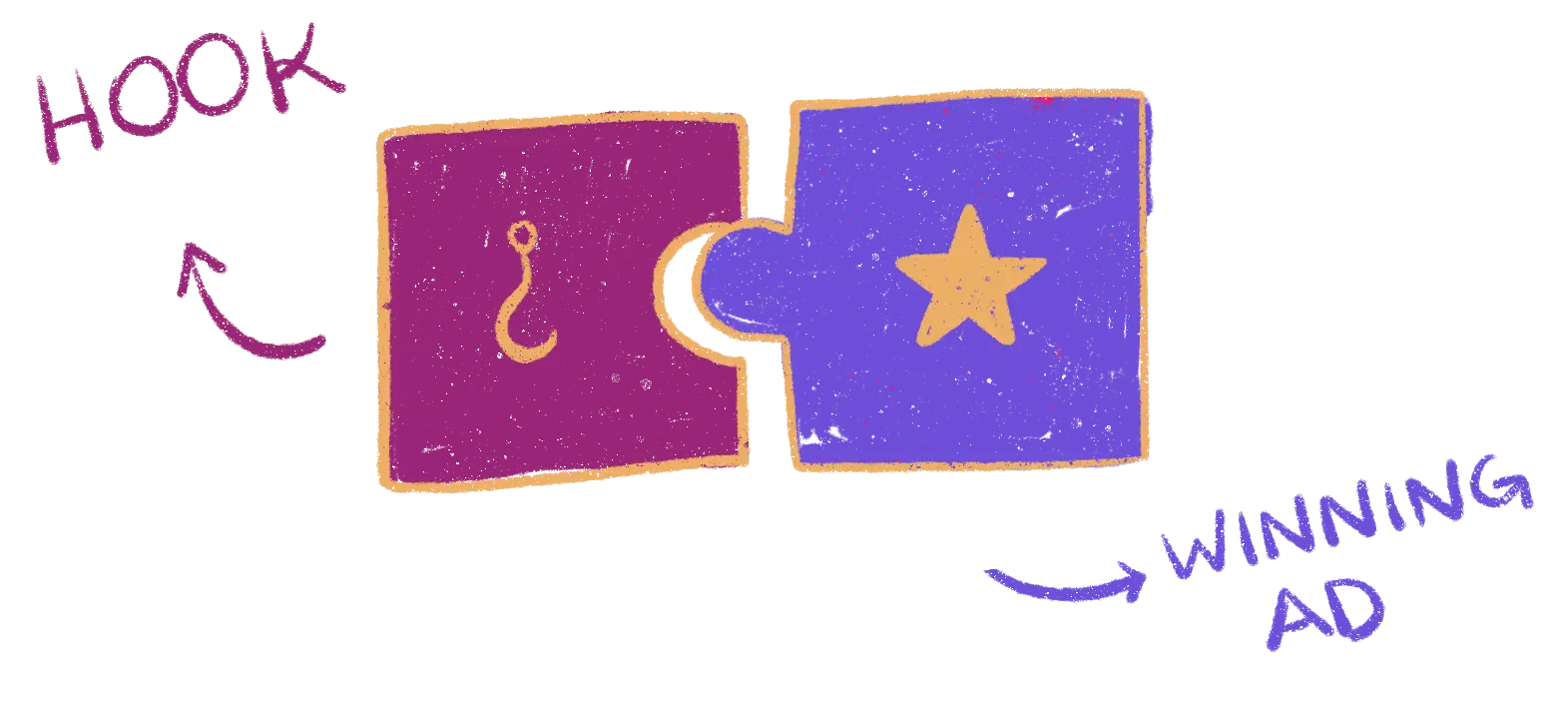
A hook iteration is a structured variation of the first 3 seconds of your video ad. You change the opening frame, the text overlay, or the spoken line while keeping everything else exactly the same. The body of the ad, the offer, the visuals, the CTA, all untouched.
This matters because the hook is the single highest-leverage variable in a video ad. It determines whether someone stops scrolling or keeps going. Everything else in your ad is irrelevant if the hook does not work.
The reason hook iterations produce faster creative learnings than rebuilding full ads from scratch is simple: you are changing one variable at a time. When you launch a completely new ad and it underperforms, you do not know what went wrong. Was it the hook? The offer? The visuals? The CTA? You have no idea. When you run hook iterations on the same base creative, you isolate the variable. You learn faster, spend less, and build a clearer picture of what your audience actually responds to.
How to Make a Hook Iteration
The process is simpler than most teams think. Here is how to do it:
Step 1: Pick your base creative. Start with an ad that has a decent body but a weak hook, or a winning ad you want to extend. The body should be solid. You are only changing the opening.
Step 2: Identify where the hook ends. Watch the first 3 seconds of your video. That is your hook. Everything after that is the body and stays untouched.
Step 3: Generate new openings. Record a new opening line in your own voice, use text-to-speech, change the first frame to a different visual, or swap the opening text overlay. You do not need a production crew. A phone recording or a quick edit works fine.
Step 4: Attach the new hook to the existing body. Splice the new 3-second opening onto the same video body. You now have a hook iteration.
Step 5: Launch and measure. Run the iterations against each other. Watch hook rate, thumbstop ratio, and watch-time drop-off to see which opening wins.
Recharm is built specifically for this workflow. Upload your base creative, extract the body, attach new hooks, and export ready-to-launch iterations in minutes without briefing anyone.
Use Recharm X Claude to build hook iterations within minutes
Examples of Hook Types
Not all hooks work the same way. Here are four types worth testing:
The Question Hook: Opens with a direct question aimed at your target audience. It creates immediate relevance by making the viewer feel like the ad is speaking to them personally. Example: "Still spending on ads that don't convert?"
The Bold Statement Hook: Opens with a provocative or counterintuitive claim that challenges a common belief. It earns attention by saying something the viewer did not expect. Example: "Your best ad is probably the one you almost killed."
The Visual Pattern Interrupt: Opens with an unexpected or unusual visual that breaks the monotony of the feed. No text, no voiceover, just a striking image or movement that makes the viewer pause. Works especially well on Instagram Reels and TikTok.
The Social Proof Hook: Opens with a result, a number, or a customer outcome. It leads with credibility before making any claim. Example: "We cut CPA by 40% without changing the offer. Here is how."
Test one hook type at a time against your base creative. Once you find the type that works for your audience, iterate within that category before branching out.
3 Reasons Why Hook Iterations Drive Better Video Ad Performance
So, yeah, you want to know why bother making hook iterations.
It’s a legit question that’s quickly answered but not easily understood. Because context matters, and every growth team’s situation is unique. So, no one but you can only tell you should use hook iterations. However, you can benefit from some common reasons why performance marketers use hook iterations.
Think of hook iterations like a skilled chef refining a recipe, tweaking ingredients and proportions until the dish is a culinary masterpiece, resonating with the palates of the diners.
1. Don’t Abandon New Ad Concepts Quickly
We spend time painstakingly researching, writing a brief, hiring agencies and creators, and fine-tuning concepts. And when they bomb upon launch, we get disheartened and abandon them quickly. Well, now you have a strategy to perfect those new concepts. Don’t give up too easily.
Hook iterations are like finding the keys to a treasure chest that are your creative concepts. It will take time, it will require trials and iterations, but you will unlock that treasure.
2. Extend Winning Ads
Isn’t it nice to find an ad that wants to consume all your ad dollars? Congrats -- you have a winning ad. Well, those winning ads are rare, but when you get those moments, you should make the most of it. How -- By making hook iterations of winning ads.
We've been able to revive old winners that were winners twelve months ago, 16 months ago. We've used Recharm to bring those back to life because a good ad is a good one, and sometimes, it just needs a new lens. Recharm allows us to give an existing winner a new lens.
3. Backup Creatives
Hook iterations are relatively faster to make (provided you have the right tools like Recharm). So, when nothing is working in your ad account, you can quickly whip up hook iterations to try new things out. Sometimes, creatives team take longer, agencies don’t deliver or you are just facing a creative block. Hook iterations is a reliable backup plan.
Harness hasty hooks with the help of handy Recharm; a haven when hindered.
The Creative Analysis Metrics That Reveal Hook Performance
Knowing your hook is not working is one thing. Knowing exactly where it is failing is another. These are the three metrics that tell you what is happening inside your hook:
3-Second View Rate (Hook Rate): This measures the percentage of people who watch at least 3 seconds of your video. It is the most direct measure of whether your hook stopped the scroll. A low hook rate means your opening is not compelling enough to earn attention. Benchmark against your own account average rather than industry numbers, since every niche behaves differently.
Thumbstop Ratio: This measures how often your ad interrupts a user mid-scroll compared to how many times it was shown. A falling thumbstop ratio means your creative is blending into the feed. If your hook rate is fine but thumbstop is dropping, the problem is likely visual. Your opening frame is not grabbing attention before the sound even kicks in.
Watch-Time Drop-Off: This shows you where in the video people are leaving. If you see a sharp drop in the first 3 seconds, the hook is the problem. If the drop happens at 8 to 10 seconds, the hook is working but the body is losing people. This distinction matters because it tells you whether to iterate the hook or rework the mid-section.
In Meta Ads Manager, find these under the Video Engagement breakdown in your ad-level reporting. On TikTok Ads, the Video Insights tab gives you a second-by-second retention curve that makes drop-off analysis much more precise.
How Often Should You Refresh Your Ad Hooks?
Hooks fatigue faster than the rest of your creative. A viewer might tolerate seeing the same ad body multiple times, but the same opening frame loses its ability to stop the scroll much sooner.
Advertisers who refresh hooks every 10 to 14 days maintain significantly higher engagement than those running the same visuals for a month or longer. The reason is frequency. As frequency climbs past 2 to 3 impressions per user, familiarity sets in and hook rate starts to drop. Refreshing the hook resets that familiarity without requiring you to rebuild the entire ad.
Here is a simple cadence framework to follow:
Watch frequency first. When your ad's frequency crosses 2.5, start preparing new hook variations. Do not wait for hook rate to drop. By the time the metrics decline visibly, you have already lost momentum.
Watch hook rate second. If hook rate drops more than 20% from its peak, that is your signal to rotate in a new hook immediately, regardless of where frequency sits.
Scale spend changes your timeline. The more budget behind an ad, the faster it fatigues. A hook that lasts three weeks at low spend may only last one week at high spend because it is reaching the same audience much faster. Adjust your refresh cadence based on daily reach, not just calendar days.
A practical starting point: review hook performance every 7 days. Refresh when frequency hits 2.5 or hook rate drops 20%, whichever comes first.
The First Three Seconds Are Everything
Most teams treat the hook as an afterthought. They spend weeks on the concept, the offer, the visuals, and the edit, and then slap on an opening and hope it works. When it does not, they scrap the whole ad and start again.
Hook iterations change that equation entirely. Instead of rebuilding from scratch every time, you isolate the one variable that determines whether anyone sees the rest of your ad in the first place. You test faster, learn faster, and get more out of every creative you have already made.
The three reasons to use hook iterations are straightforward: rescue concepts that deserved a better opening, extend winning ads that still have life in them, and keep your account moving when your creative pipeline slows down.
But the underlying principle is simpler than all of that. A great ad with a bad hook is an ad nobody watches. A decent ad with a great hook is an ad that gets a chance. Give your ads that chance.
Frequently Asked Questions
What is a hook iteration and how is it different from creating a new ad?
A hook iteration changes only the first 3 seconds of an existing video ad. The body, the offer, the visuals, and the CTA all stay exactly the same. Creating a new ad means rebuilding everything from scratch. The difference matters because hook iterations isolate a single variable, so when performance changes, you know exactly why. With a brand new ad, you have no idea which element made the difference.
How many hook variations should I test at the same time?
Start with 3 to 5 variations per base creative. Too few and you do not have enough data to draw conclusions. Too many and your budget gets spread too thin for any single variation to generate statistically meaningful results. Let them run until each has at least 1,000 impressions before making any decisions. Once a winner emerges, pause the rest and iterate further on the winning hook type.
How do I analyse which part of my hook is causing drop-off?
Go to your Video Engagement breakdown in Meta Ads Manager and look at your watch-time drop-off curve. A sharp drop in the first 1 to 2 seconds means your opening frame is the problem, the visual is not stopping the scroll before sound even plays. A drop between 2 and 3 seconds means the opening line or text overlay is losing people. Once you identify where the drop happens, change only that element in your next iteration and keep everything else the same.