"It's faster" is not a reason to change how a team works. Every new tool claims to be faster. The real question is what a tool lets you do that you genuinely could not do before, or could not do without a specific skill sitting in the way. That's a much higher bar, and it's the one worth actually answering before anyone rethinks their creative workflow around a new approach.
That's the gap agentic video editing closes, and it turns out to be three separate gaps, not one. Speed solves a production problem. Prototyping solves an access problem. Quality control solves a trust problem. Three different people on a creative team feel these three gaps differently, and understanding which one actually applies to your situation matters more than any generic "AI edits video now" pitch.
This piece walks through all three in real detail, plus a fourth thing worth knowing: the specific kinds of editing decisions that are genuinely difficult for humans to execute consistently, but straightforward for an agentic process to apply every time.
TL;DR
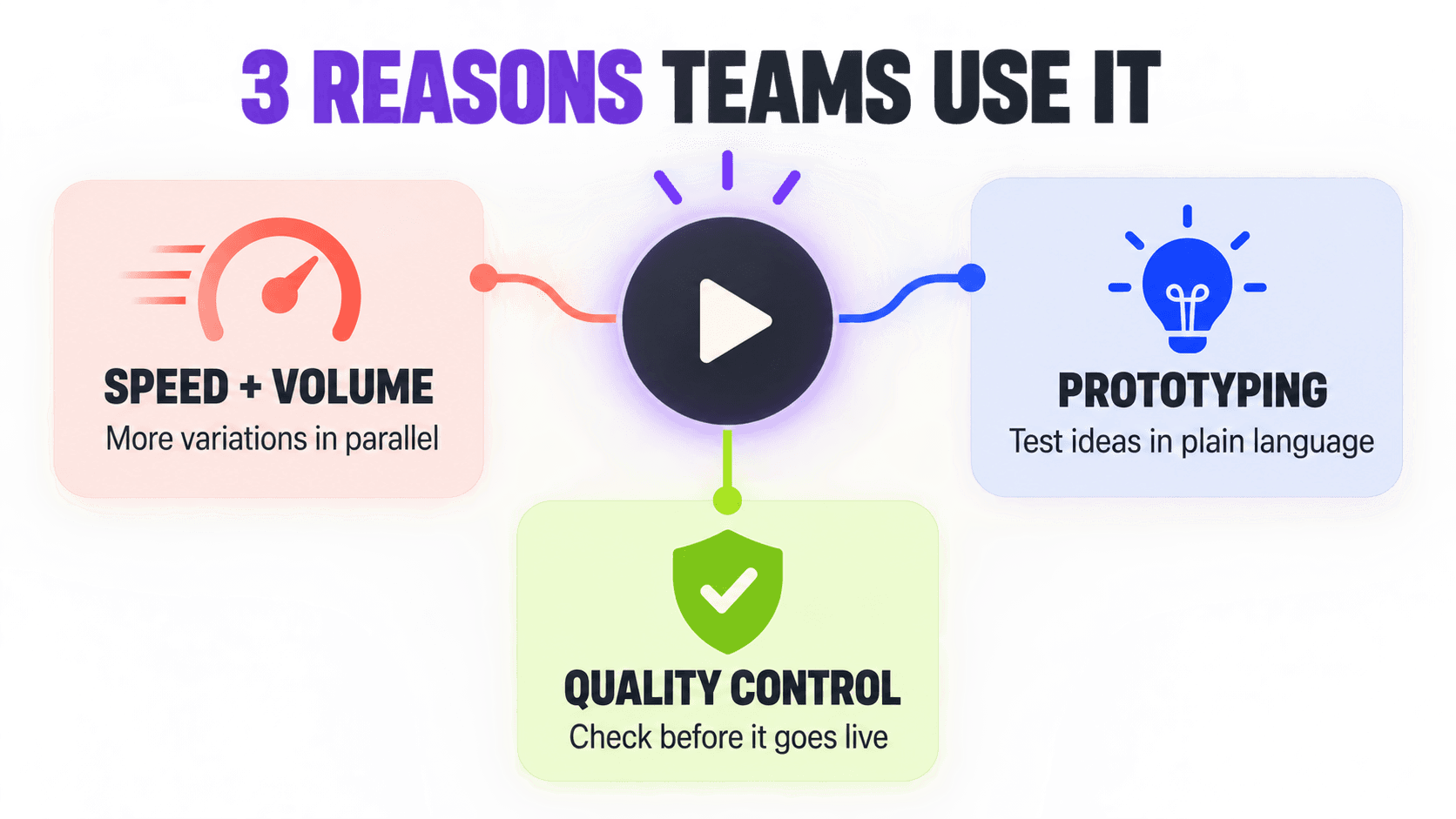
Speed and volume: Editing sessions can run in parallel rather than one after another, which matters most when the goal is many ad variations, not one polished cut.
Diversity and prototyping: Someone with no video editing training can test a creative concept just by describing it in plain language, removing the wait on editor bandwidth that quietly kills a lot of untested ideas.
Quality control: The process checks its own work at the scene level while assembling a cut, and again across the whole video afterward, covering things like caption alignment, audio levels, and safe zones.
Technique consistency: Simple but time-consuming decisions like J-cuts, L-cuts, and other common transitions get skipped under deadline pressure by hand, but can be applied consistently without that tradeoff.
These four things solve different problems for different roles: production speed for editors, idea validation for creative strategists, and consistency for anyone reviewing final output before it runs as a live ad.
Speed and Volume
The most visible benefit is also the least interesting on its own: producing more ad variations faster than cutting them one at a time by hand. Stated like that, it barely says anything a person hasn't heard from every editing tool that's ever claimed to save time.
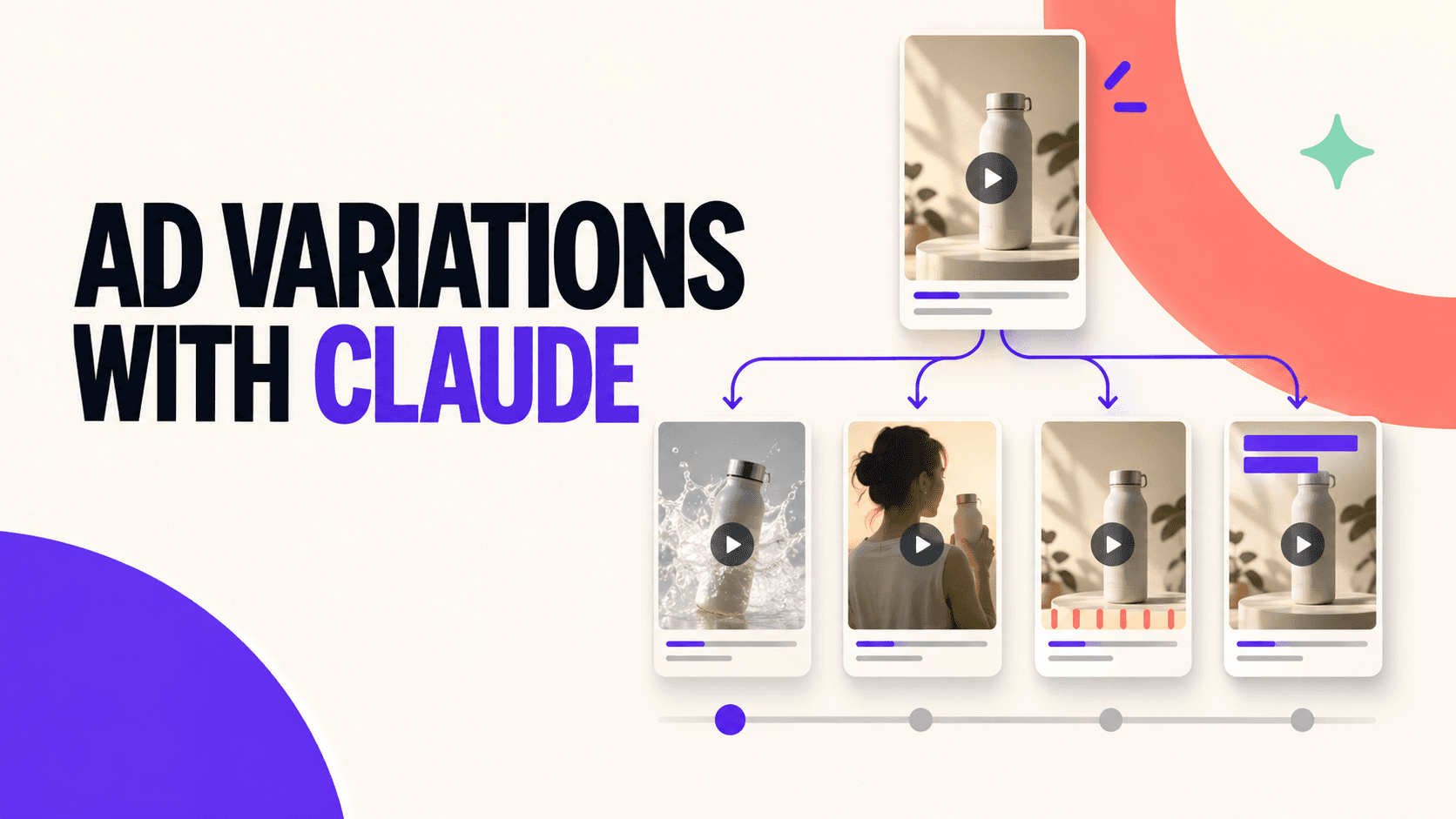
What actually changes the math is that multiple editing sessions can run in parallel, rather than one editor moving through five variations in sequence. You can work through several versions of the same concept at once, and the strongest output gets picked from the set. That's a structurally different production model, not a faster version of the same one.
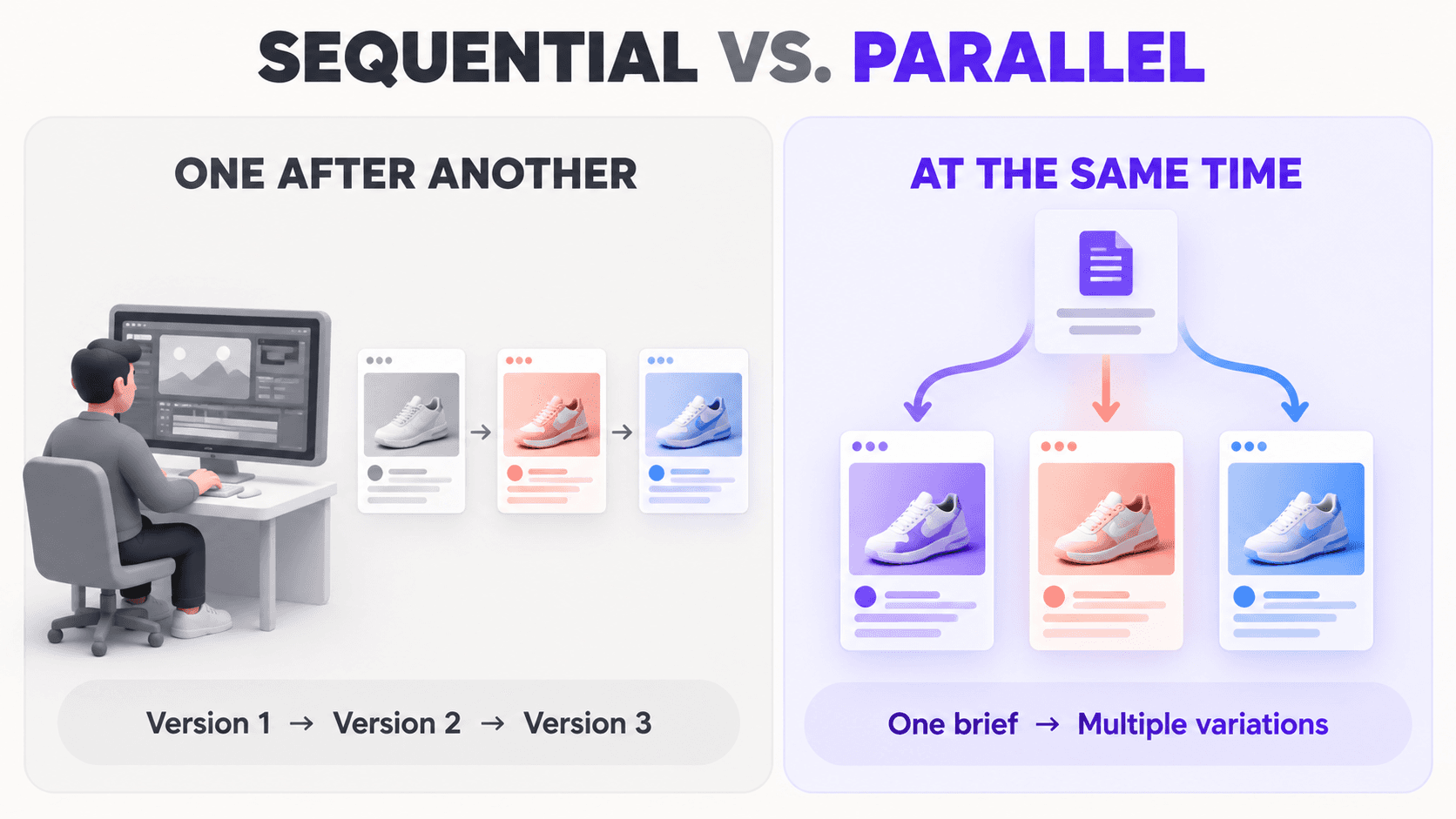
This matters most for teams whose entire testing strategy depends on volume. Ad fatigue is real and it moves fast; a hook that performs well in week one can be dead by week three, and the only real defense is having fresh variations ready before that happens. A team that can only produce variations sequentially is always playing catch-up against its own ad accounts. Parallel production changes that from a constant scramble into something closer to a standing pipeline.
Diversity and Prototyping
This is the piece that matters most for people who are not editors at all, and it's arguably the more interesting shift of the three.
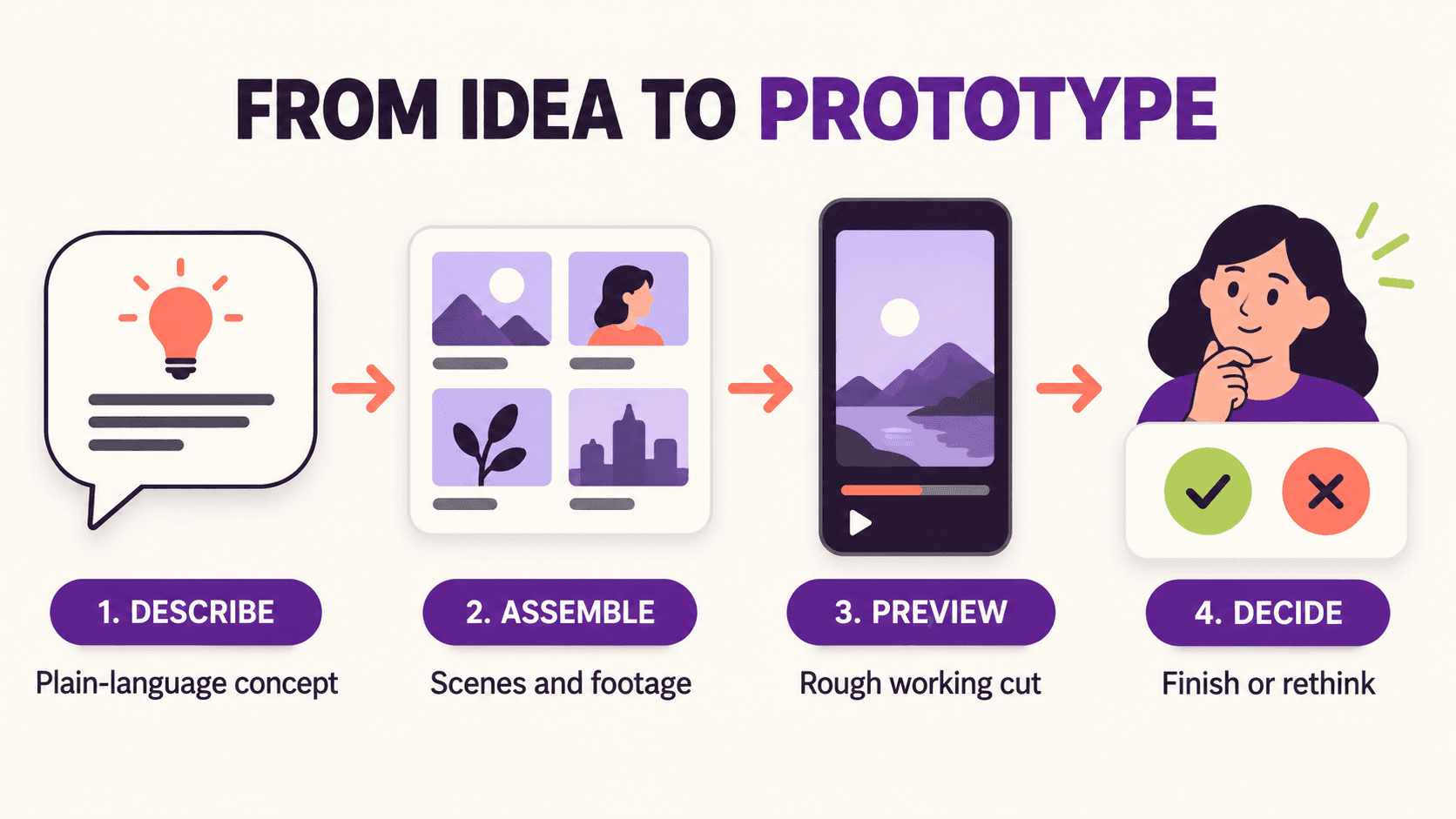
Historically, testing a new creative concept meant one of two things: learning video editing software yourself, or waiting for an editor's time to free up. Neither is fast, and the second one in particular quietly kills good ideas before they're ever tested. Not because the idea was weak, but because nobody had the bandwidth or the specific skill to try it quickly enough for it to still feel worth pursuing by the time it got made.
Agentic editing removes that dependency. A creative strategist can describe a concept in plain language, open on the problem, cut to a product close-up, land on the testimonial, and get a rough version back without opening a timeline or learning a single editing tool. The point is not to bypass editors entirely. It's to let more people test more ideas before anyone commits real editing time to the ones actually worth pursuing, so editing hours go toward concepts that have already shown some promise instead of being spent finding out whether an idea works at all.
This also changes the nature of the conversation between a creative strategist and an editor. Instead of pitching a concept on a slide and hoping it lands the way it does in your head, you can show a rough version of the actual thing. "Here's roughly what this looks like, is it worth finishing properly?" is a very different, and much more productive, starting point than "I think this could work."
Quality Control
This is the part that's easiest to underestimate, and probably the one that matters most for whether any of this is actually trustworthy enough to use on real ad creative.
This is not a single-pass process that produces something and hopes it's right. Two separate checks happen. While a cut is being assembled, it gets checked scene by scene and frame by frame as it goes, not just at the end. Then, once the full edit exists, it gets reviewed again as a whole: caption timing and alignment, audio level consistency across cuts, and whether on-screen text actually sits inside the safe zones for whatever platform the ad is built for, rather than getting clipped at the edge of the frame or overlapped by an interface element.
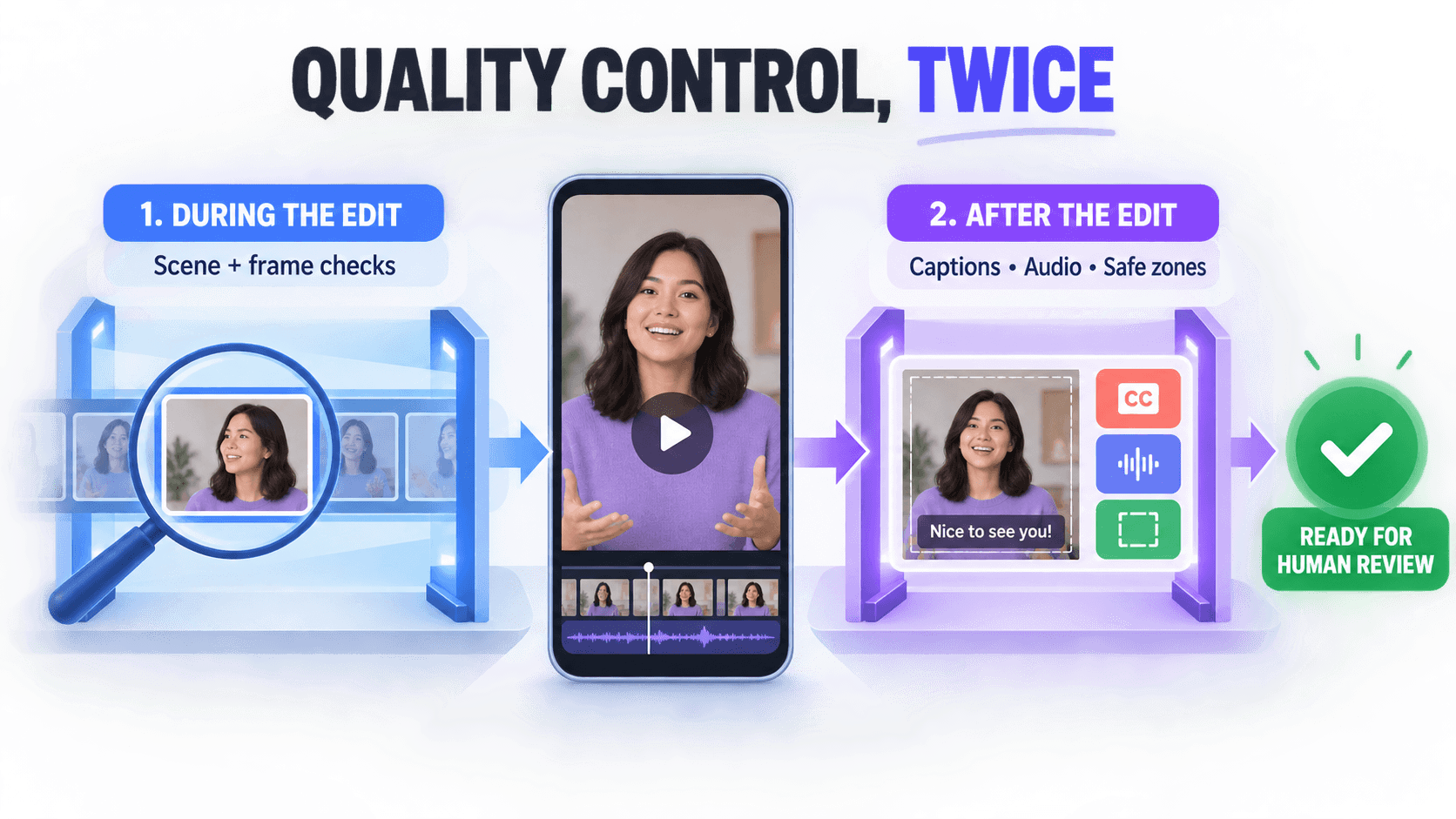
The reason this matters goes beyond "make sure it looks clean." The actual failure mode people worry about with any AI-assisted production process is not "it'll look bad"; it's "it'll get something specific wrong, and nobody will catch it before it goes live." A product shown out of frame at the wrong moment. A line of dialogue paired with the wrong visual. A caption that runs off the edge of a mobile screen. These are small, specific errors, exactly the kind that are easy to miss in a quick human review pass, especially under deadline pressure, and exactly the kind a built-in, structured review process is designed to catch before a human ever signs off.
Building that review into the process itself, rather than leaving it entirely to whoever happens to eyeball the final export, is what turns this from "interesting but risky" into something a team can actually rely on for creative that's going to run as a paid ad.
The Kind of Editing Work Humans Skip Because It's Tedious
Some editing decisions are simple but time-consuming, like J-cuts, L-cuts, and other common transitions. They genuinely make a cut feel more polished, and they're also tedious enough to execute by hand that they get skipped under time pressure more often than anyone would admit.
Two clear examples: a J-cut, where the audio from the next scene starts playing before the picture has cut to it, and an L-cut, where the audio from the current scene continues for a beat after the picture has already moved on.
Both exist to soften a transition so it feels like a natural continuation of the conversation instead of an abrupt jump. Both require careful, manual placement to get the timing right, nudging an audio clip a few frames one way or the other until it lands. It's exactly the kind of detail that separates a genuinely well-edited cut from a merely functional one, and exactly the kind of detail that quietly gets dropped when an editor has six more variations to finish before the end of the day.
An agentic editing process can apply that same technique consistently, every time, without it costing extra time relative to a simpler cut. It's not that a human editor doesn't know how to do this. It's that doing it well, every single time, across a high volume of variations, is a different kind of consistency than any individual editor can realistically sustain.
The same logic extends to filling gaps in available footage. One real example involved building short motion-graphics segments to cover a moment where the existing footage simply didn't have the right shot, dividing a composition into percentage-based sections and using slideshow-style product visuals to bridge the gap cleanly. That's a solution a skilled human editor would think of too. It's simply one more manual production step that an agentic process can generate directly as part of the edit, rather than as a separate task someone has to remember to go build.
Where This Still Needs a Human
None of the above replaces creative judgment, and it's not meant to. Deciding whether an angle is actually good, whether a claim is on-brand and defensible, whether a concept is worth testing in the first place, that's still entirely a human call, and it should stay that way.
What changes is how much gets tested before a human has to make that call, and how much tedious, repetitive production work stands between having an idea and actually seeing it as a real video. That's the honest version of the pitch: not "this replaces creative thinking," but "this removes the production bottleneck that used to sit between a good idea and finding out whether it was actually good."
FAQs
Does This Replace Video Editors?
No. It removes the bottleneck between having an idea and seeing a rough version of it, which mainly helps people who are not editors, letting them test concepts directly instead of waiting on an editor's availability or learning editing software themselves. Editors still make the calls on which concepts are worth a full, polished production pass.
How Does the Quality Control Process Actually Work?
It happens in two stages. While a cut is being assembled, it's checked scene by scene and frame by frame as it goes. Once the full edit exists, it gets reviewed again as a whole, covering caption alignment, audio level consistency across cuts, and whether on-screen text stays inside the safe zones for the platform it's built for.
What Are J-Cuts and L-Cuts, and Why Do They Matter Here?
A J-cut is when the audio from the next scene starts before the picture has cut to it. An L-cut is the reverse: the audio from the current scene continues briefly after the picture has already moved on. Both make transitions feel natural instead of abrupt, and both require careful manual timing to execute well, which is exactly the kind of detail that's easy to skip under deadline pressure but straightforward to apply consistently in an agentic editing process.
What's the Real Advantage Over Manual Editing, Beyond Raw Speed?
The biggest structural shift is that multiple variations can be produced in parallel instead of sequentially, and that people without editing skills can test creative concepts directly instead of waiting on an editor's time. Speed on any single edit is real but