
Scaling paid ads often feels like a rocket launch that sputters after liftoff. You find a winner, double (or triple!) the budget and weeks later ROAS tanks. This “double-your-budget, tank-your-ROAS” scenario is all too common. The culprit isn’t usually bidding or budgets; it’s creative fatigue. Modern ad engines (Meta’s Andromeda, TikTok’s AI, etc.) need fresh, diverse ads to keep performance steady. This guide walks you through a playbook for DTC performance marketers: how to audit your setup, build a creative production engine, optimize budgets and campaigns, and retarget smarter – all without creative burnout.
TL;DR
The scale wall: Pumping money into one ad temporarily boosts metrics, then costs skyrocket as audiences and algorithms tune out.
The real fix: Treat creative like infrastructure. You need a pipeline of new hooks, angles, and formats – not just a pile of ad spends. Meta’s latest changes (Advantage+, Andromeda) mean creative diversity is your main lever.
Step-by-step: Audit your current setup and fatigue signals. Fix your creative library and workflows. Build a system for constant new variants. Scale budgets slowly and flexibly. Consolidate campaigns to give the algorithm strong signals. Rotate ads proactively. Tailor retargeting creatives by audience depth.
Don’t: Scale before your creative library can handle it, rely on “10 ads with one idea”, or ignore the retargeting ads. Growth comes from creative ops as much as media ops.
By following this playbook, you build a creative engine that feeds the algorithm with diversity and freshness, the only sustainable way to grow spend in 2026 and beyond.
Why Most Brands Fail When Scaling Horizontally
The linear myth: Scaling isn’t a straight line. Early budget gets you low-hanging fruit (the eager audience with cheap conversions). But after ~50% audience penetration, costs surge and conversions dry up. Doubling the budget simply exhausts the easy audience, forcing you to pay more per impression. The result: rising CPMs, falling click-throughs, and exploding CPAs.
Ad fatigue mechanics: In performance marketing, audiences get bored quickly. High frequency (each person seeing your ad 3–4+ times per week) sharply drops engagement. The only remedy is new creative. Without fresh hooks, the algorithm flags your ad as “less engaging” and bids skyrocket.
The shallow diversity trap: A deadly mistake is cosmetic variation masquerading as diversity. Three ads with the same core hook – maybe just different filters or a new logo – are virtually one creative to the algorithm. Meta detects near-duplicates and will flood the same users with essentially the same message. Shallow tweaks do almost nothing to combat fatigue or unlock new audiences.
Creative output vs. spend level: At scale, you need volume. Admetrics research shows high-performing DTC accounts maintain 8–12 distinct creative variations per campaign, refreshing ~25–30% of them each month. If you’re running $50K/day, that often means dozens of new video ads per week. Most teams only crank out 5–10; that gap is where scaling dies. In short, if you double spend without expanding your creative library by a similar factor, results crater.
“Your ad’s creative signals determine auction access, reach, and costs. You win today by feeding algorithms new, diverse creatives – not better bid hacks.”
What’s the Real Answer to Scaling Ads Profitably?
The old model (fixing audiences and bids) is dead. Today, creative is infrastructure. Smart brands treat video/photo assets like a production facility: constantly churning content. High volume and high diversity of ads protect your ROAS. Algorithms reward variety – different angles, formats, and stories – because fresh content keeps users clicking. In fact, Meta’s new system (Andromeda) now uses creative signals to shortlist ads for each impression. Appsflyer data suggests 70–80% of Meta ad performance now comes from creative quality, not targeting. In other words, creative diversity is targeting now.
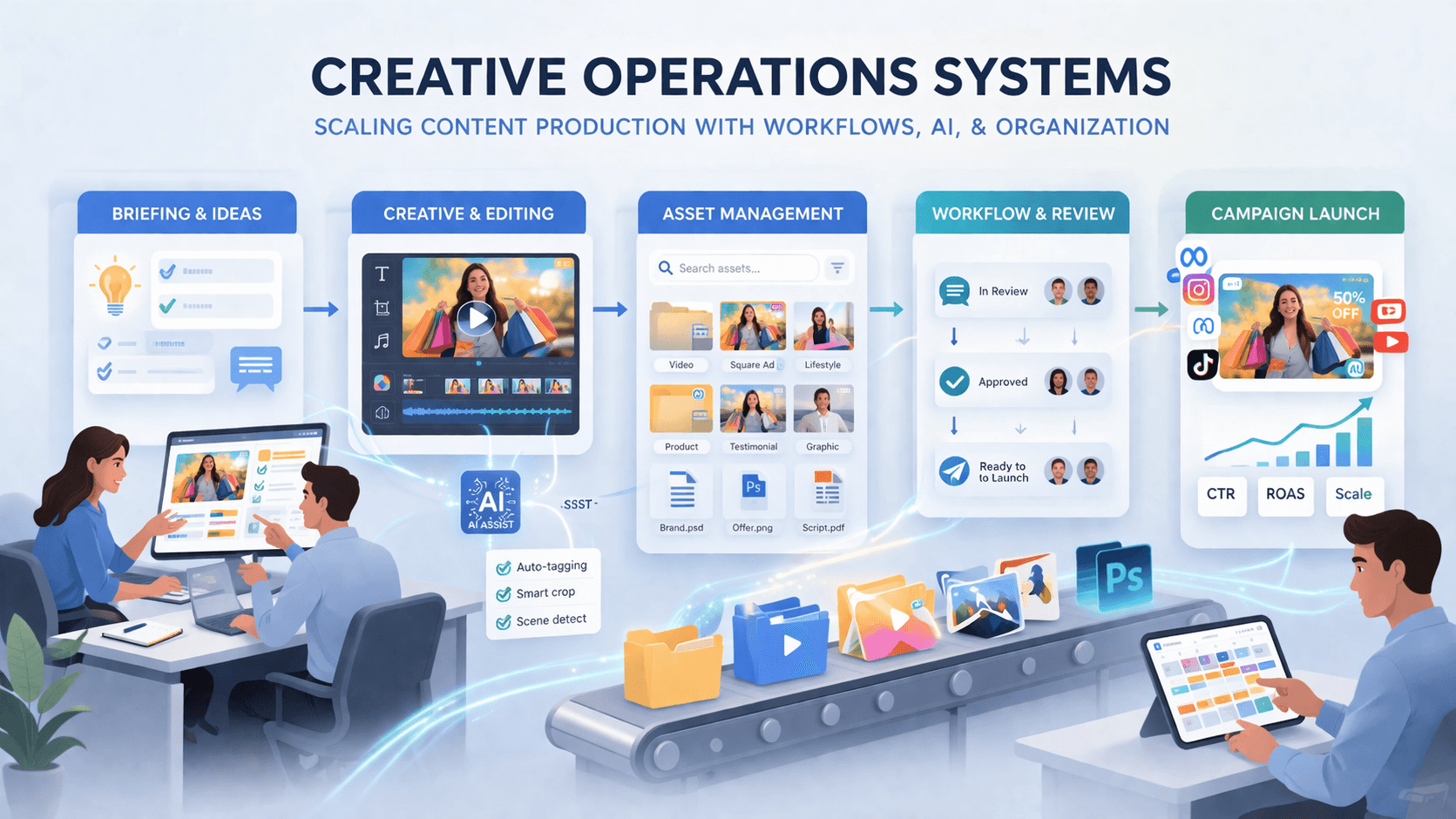
The core of scaling is a creative system. It’s a repeatable pipeline that outputs and tests new hooks, personas, CTAs and formats. You need processes (not just “hire more editors”) – from shot planning and asset tagging to structured A/B testing. With such a system, you treat creative like the primary growth lever. Meta and TikTok’s automation (Advantage+, smart bidding, etc.) handle who sees your ads – your job is to keep the “what” (the ads themselves) fresh and plentiful.
Step 1: Audit Your Current Ad Setup
Begin by dissecting your campaigns and creativity. These diagnostics reveal where to act first:
Identify your ROAS floor: What’s the minimum ROAS you can accept on existing campaigns? If you scale below that threshold, losses compound. Only consider budget lifts on campaigns already meeting your profit target.
Map creative fatigue: Check frequency scores and CTR trends for every active ad. If any ad hits a frequency >3–4 per week, or its CTR has fallen ~20% in 1–2 weeks, the audience is tiring. Mark those ads for immediate rotation. Don’t hike spend on campaigns where creatives are already fatigued.
Audit creative diversity: List all active ads by hook/angle, persona, format, and product focus. Are 70% of them telling the same story? If so, your library is shallow. A good rule: no single hook/angle should dominate more than ~30% of spend. If it does, the algorithm has too few unique signals.
Identify the creative bottleneck: How long does it take from raw footage to a published ad variant? If each new video ad needs 3+ days, your production is a drag on scaling. Figure out if sourcing footage, editing, or approvals are the slowdown. The faster you can spin up “draft” ads from new footage (say, <48h), the easier scale becomes.
Step 2: Fix Your Creative Infrastructure
Many teams suffer from a chaotic “footage junk drawer.” Hundreds of gigabytes of untagged UGC, influencer clips, and B-roll sit in Google Drive – effectively hidden. This disorganization kills speed. Instead:
Organize for modular reuse: Ditch nested folders. (They’re where videos go to hide.) Use a tagged library or DAM that treats videos as time-series data, not just blobs. Tools built for ads (like Recharm) break footage into shots, hooks, testimonials, etc., all tagged by persona or product. That way a strategist can instantly search for “hook: complaint, product: serum” and retrieve a 3-sec clip instead of scrubbing a full file.
Auto-ingest and search: Connect your camera roll, Frame.io or Google Drive to auto-import new raw videos. Ensure your system has universal search: find words in transcripts, faces in shots, or objects. This drastically cuts lookup time. The goal is: your team doesn’t say “I think we have something like this somewhere” – they know it’s one search away.
Deep linking & workflows: Equip your team to share exact moments, not timecodes. Deep links into videos (jumping to second 12 of the file) eliminate confusion. Standardize briefs by linking to the shot and pulling associated tags (hook type, CTA, etc.). When infrastructure supports collaboration, ideas flow fast.
By building a modular creative library, you remove friction: reuse old footage by simply grabbing shots, not re-shooting every time. This library is the bedrock for rapid iteration.
Step 3: Build a Creative System That Produces Hooks, Variants, and Iterations
Having fixed your library, the next step is setting rules for content creation and testing.
Define your creative taxonomy: Agree on consistent categories and tags for every asset and idea. For example: Hook Type (e.g. pain point, surprise fact), CTA Style (coupon vs. UGC ask), Persona (Mom, athlete, influencer), Value Angle (sustainability, innovation), Product Feature (size, scent). Tag all existing footage and scripts accordingly. This common language lets everyone communicate and search unambiguously.
Hook-first testing: Recognize that the first 2–3 seconds of a video (the hook) dictate ~80% of engagement. Structure testing sprints by varying the hook while keeping everything else constant. Identify which hook “attaches” most eyes. Only after a winning hook is found, tinker with other elements. (Shiny editing won’t save a weak hook.)
Iteration vs. variation: Know the difference. An iteration tweaks a known winner (e.g. change a headline, color, or text overlay). A variation changes the strategic hypothesis (e.g. a new persona, storyline, or emotional tone). Both matter, but only variations produce fundamentally new signals. If all you do is iterate, audiences won’t see a “new” idea, and the algorithm sees redundancy. Aim for a mix: reuse successful formats (iterate them) and introduce completely new concepts regularly.
The 8–12 rule: High-scale accounts don’t run just 2–3 ads per campaign – they actively manage 8–12 distinct ads per campaign. That means multiple videos (or statics) per audience, each with a different angle. Roughly 25–30% of those should be replaced or refreshed monthly. In practical terms, plan to launch several new creative variants each week across your campaigns, so the library is always expanding and old ads retire.
Repurpose before you shoot: Remember that treasure troves of footage already exist in your archives. Before scheduling another shoot, comb through your tagged library for usable clips. Often you have weeks of influencer/UCG clips or B-roll that can be re-cut into new ads with voiceovers or text. With a good DAM (see Step 2), repurposing UGC is a superpower – you can meet the above creative velocity goals without always sourcing fresh shoots. This efficient reuse keeps costs down and variety up.
Step 4: Optimise Campaign Structure and Budget Incrementally
With creative pumped up, turn to media strategy:
Never double the budget at once: A sudden +50% or +100% spike sends the ad network back into “learning mode” and nearly resets your ROAS. A safer rule is ~20% increases, one step at a time. Each ~20% bump lets you ease into more spend without jarring the delivery algorithm.
Budget by proven creative: Only scale campaigns where the creative has settled post-learning (5+ days on stable ROAS). Check that multiple ads in the set are hitting goals. Identify which ads are actually driving results and pour the incremental budget into that batch, not the underperformers.
Embrace Advantage+ and ASC: Meta’s Advantage+ Shopping and Advantage+ App Campaigns consolidate optimization. They auto-allocate budgets across audiences and creative. In this world, your lever isn’t audience splits (most targeting is broad now) – it’s creative. Focus on giving these campaigns a mix of excellent creatives. The platform will find users; your job is to win their attention. As Media Performance notes, manual targeting is largely gone and creative quality drives performance now.
Avoid spreading too thin: Don’t launch 10 nearly-identical campaigns with $500 each. It starves every ad of data. Instead, concentrate budget into fewer campaigns (or even one “mother campaign” in Advantage+) filled with your 8–12 best creative variants. This gives the system a stronger signal to learn quickly.
Step 5: Simplify Your Campaign Architecture
Less is more when scaling:
Consolidate for signal strength: By merging similar audiences/campaigns, you feed each campaign more conversions. Meta’s algorithm learns faster with larger data sets. For example, instead of separate ads for Product A/Region 1 vs. Product A/Region 2, test combining them under one umbrella and use creative to localize messaging.
Kill losers fast: Establish clear cut-offs. A good rule: if a creative gets ~500+ impressions and has a CTR or conversion rate that’s markedly below your averages (e.g. CTR down >20%), pause it. Don’t let budget waste on it. Scale winners, kill flops – quickly reallocating funds.
Creative rotation cadence: Schedule a weekly “creative ops” review (e.g. every Monday). Check all live ads:
Retire the 1–2 creatives with rising CPAs or declining CTR.
Introduce 2–3 new variants (made from your pipeline).
Refresh any ad copy or thumbnails showing fatigue.
Consistent turnover keeps a healthy buffer of tested content. Treat these as routine maintenance, not an afterthought.
Step 6: Retargeting by Creative Angle and Audience Level
Retargeting audiences see your ads much more often than cold prospects, so fatigue hits here first:
Retargeting creative diversity: Don’t show the same “Hey, come back” ad for weeks on end. Refresh retargeting ads even more often than prospecting. For example, rotate testimonials, special offer hooks, and new UGC testimonials regularly.
Segment by engagement depth: Break retargeting into layers – e.g. viewed 25%, 50%, 75% of a video; site visitors; cart abandoners; checkout abandoners – and tailor creative accordingly. Someone who watched 75% of your product demo ad wants different messaging than a casual site visitor. Use deeper proof (UGC praise, reviews) as people get warmer, and angle more hard on purchase intent later.
Proof and testimonials: Retargeting is prime real estate for social proof. Ads highlighting reviews, before/after results, or user-generated clips typically outperform generic ads for warm lists. Have these clips pre-tagged in your library for instant use.
Cross-platform retargeting: If you prospect on TikTok, retarget those same users on Meta/YouTube (and vice versa). But adapt the creative format: a TikTok clip may work on FB Stories, but create a horizontal or square version with different overlay text for Instagram Feed. Never just copy-paste one ad file across all platforms. Each channel’s native style (aspect ratio, pacing, copy style) should be considered.
Common Mistakes to Avoid When Scaling Online Advertising
Scaling before creative is ready: It’s tempting to just turn up the media spend, but without a robust creative supply that capability backfires. The moment you increase budget on a depleted creative set, CPAs spike. Always shore up your library (see Steps 2–3) before pressing harder on budgets.
Shallow creative diversity: Launching 10 ads that all say the same thing in a slightly different voice is not real testing; it’s just noise. The algorithm will group them as duplicates. Prioritize truly distinct personas, hooks, and emotional drivers. Treat each new ad like an experiment, not a pixel-shift of the last one.
Inconsistent creative velocity: Don’t binge-and-bust. Pumping out 20 new ads one month and zero the next wrecks the learning process. The key is a steady cadence: aim for 5–10 net-new variations every week. Even a small account can sustain growth if it keeps a regular creative output schedule.
Neglecting retargeting creative: It’s common to focus budgets on new user acquisition and forget that retargeting ads also age out. Yet retargeted audiences have already proven interest, so stale ads are a wasted opportunity. Dedicate ~20% of new creative slots just for retargeting messages. Fresh angles here can re-capture nearly-won customers.
Ignoring the creative infrastructure: Many teams suffer from “file chaos.” When nobody can find old footage, you end up shooting from scratch too often. This compounds costs as your ad spend rises. Invest in a DAM designed for ads (with tagging, search, deep linking) early on. A messy library is a hidden tax on scaling – fix it first.
Recharm: The Solution for Scaling Ad Creative
Building the systems above sounds daunting – that’s where specialized tools help. Recharm is a creative ops platform built for exactly this purpose. Rather than forcing your team back into folder chaos, Recharm treats your video library like a production engine:
Video as content, not files: Recharm explodes video files into clips by hook, testimonial, product shot, etc., so you can search the content itself. No more downloading 20-min clips just to find a 3-sec moment.
Consistent tagging: It auto-tags by creator, product, persona, and angle – not just generic objects. For example, click on an influencer’s face and instantly see every clip they appear in. This opinionated taxonomy means “Caroline + Bronzer + Hook” retrieval is instant.
Speed and deep linking: Unlike general DAMs (Air, Google Drive, etc.), Recharm is built for speed. Its cockpit-style interface puts every control at your fingertips. You can copy a direct link to a specific second of video (deep link) and pass it to editors – no timecode confusion.
Self-organizing library: Recharm’s library cleans itself. New footage auto-ingests from Google Drive, Frame.io, etc., and is categorized the moment it arrives (by speech-to-text, face recognition, and your taxonomies). You spend time creating, not filing. In short, Recharm is less a “storage locker” and more a searchable creative studio.
Using such a tool means your creative pipeline becomes more productive. Your team spends less time searching for clips and more time experimenting with new ads. In effect, Recharm helps you turn archival footage into a “factory floor” for ad production. This infrastructure removes the biggest bottleneck we identified, enabling you to churn out and test new creative at the velocity needed to scale.
Frequently Asked Questions
Q: Why does increasing my Meta ad budget always tank my ROAS?
Increasing budgets exposes your ads to a larger and often less responsive audience while existing creatives may already be fatigued. As engagement declines, CPAs tend to rise. Scaling budgets gradually and introducing fresh creatives at the same time usually helps maintain performance.
Q: How many creative variations do I actually need to scale ads on Meta?
High-growth accounts usually run 8–12 active creatives per campaign, each with a different angle or hook. Around 25–30% of the creative library should refresh monthly to prevent fatigue. If you're running only a few ads at a time, scaling will be difficult.
Q: What is the “20% budget rule” for scaling ads, and does it still apply with Advantage+?
The 20% rule suggests increasing campaign budgets gradually, typically by no more than 20% at a time, to avoid resetting the algorithm’s learning phase. Even with Advantage+ campaigns, gradual scaling tends to keep performance more stable.
Q: How do I scale ad creative production without constantly commissioning new shoots?
Start by repurposing existing footage. Many brands already have unused UGC, product demos, or B-roll that can be re-cut into new variations. With a well-organized asset library and tagging system, teams can quickly assemble fresh creatives from existing clips.
Q: What is creative diversity, and why does it matter for Meta’s algorithm?
Creative diversity means testing genuinely different ads with different hooks, angles, and messaging. Meta’s delivery system uses creative signals to find the right audience. When campaigns rely on only a few similar ads, performance often declines.
Q: How do I know when an ad is fatigued and needs to be rotated out?
Ad fatigue usually appears when frequency rises while engagement drops. If CTR declines consistently or CPAs increase after steady delivery, it’s often time to pause the ad and introduce a new variation.