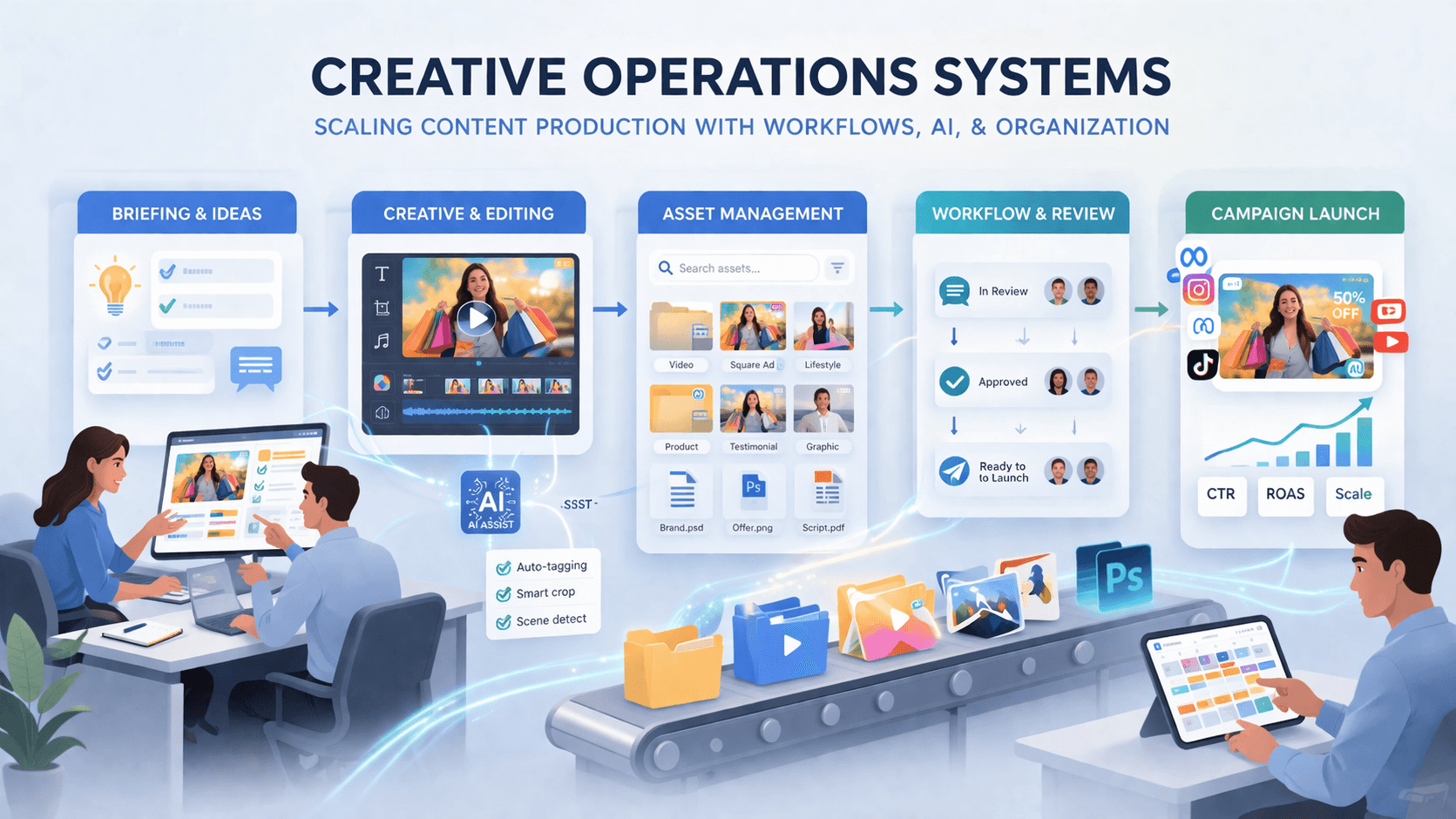

Creative teams today produce far more content than they did a decade ago. Every platform demands constant creative updates, and most campaigns require multiple variations to stay effective.
Producing more assets cannot always mean hiring more people or increasing budgets. Teams need systems that help them scale creative output without slowing down workflows.
This is where creative operations come in. It focuses on building the processes, tools, and infrastructure that allow creative teams to produce more work efficiently. Here is how creative operations work and how teams can scale creative production without sacrificing quality.
TL;DR
Creative operations is the system that allows creative teams to produce more work efficiently without increasing headcount.
It combines three elements:
structured workflows
the right technology stack
collaboration between creative and marketing teams
When implemented properly, creative operations improve:
creative production speed
asset discoverability
collaboration across teams
creative experimentation
For video-heavy marketing teams, technologies such as AI tagging, transcript search, and centralized video asset libraries make it significantly easier to reuse existing footage instead of constantly producing new content.
Platforms like Recharm organize video assets into modular components such as hooks, testimonials, and CTAs, helping teams find and reuse winning creative elements quickly.
What is Creative Operations?
Creative operations, often referred to as creative ops, is the discipline of building and managing systems that allow creative teams to produce work consistently and at scale.
Rather than focusing on individual campaigns, creative ops focuses on the infrastructure behind creative production. The goal is to remove operational friction so designers, editors, and strategists can focus on creative thinking rather than administrative tasks.
Creative operations typically manage the full lifecycle of creative work.
Key responsibilities include:
project intake and brief management
resource allocation and capacity planning
workflow design and standardization
asset management and discoverability
review, approval, and version control
performance feedback and iteration
In modern marketing teams, creative ops also acts as a knowledge management system. Creative assets such as hooks, testimonials, UGC clips, and product shots are archived, tagged, and made searchable so teams can reuse them across campaigns.
The Explosion in Demand for Creative Operations
The demand for creative operations has increased dramatically as marketing teams produce more digital content than ever before.
According to Adobe’s State of Content report, 88% of marketing leaders say demand for content has doubled in recent years.
At the same time, global digital video advertising spending is expected to exceed $223 billion, highlighting how important video has become in modern marketing strategies. Several factors are driving this rapid increase in creative demand.
Algorithms reward creative variety
Modern platforms such as TikTok, YouTube Shorts, and Meta prioritize creative diversity. Running multiple creative variations helps algorithms match different messages with different audience segments.
Ad fatigue is accelerating
Research from Nielsen shows that creative quality contributes nearly 50% of advertising effectiveness.
Source: https://www.nielsen.com/insights/2017/the-role-of-creative-in-advertising/
However, even strong ads lose performance over time as audiences repeatedly see the same creative. This forces marketing teams to produce new variations continuously.
Production budgets cannot scale endlessly
Most brands cannot simply increase production budgets to meet rising content demand. Instead, they need systems that help them extract more value from existing creative assets. Creative operations frameworks allow teams to reuse clips, remix footage, and scale production efficiently.
3 Key Elements of Creative Operations
Every creative operations framework is built on three pillars: people, process, and technology.
People
A mature creative ops structure typically includes roles such as:
Creative Operations Manager
Digital Asset Manager
Creative Strategist
Video Editor
Each role focuses on a specific stage of the creative lifecycle, ensuring that ideas move efficiently from concept to execution.
Process
Clear workflows help teams scale production. Standardized processes ensure every project follows consistent steps for briefing, production, review, and deployment. When processes are clearly defined, teams spend less time figuring out what to do next and more time executing creative work.
Technology
Technology enables creative operations to scale. Tools such as asset management systems, workflow platforms, and collaboration software help teams manage large volumes of creative assets efficiently. For video teams, capabilities like AI tagging, transcript search, and modular clip organization dramatically reduce the time spent searching for footage.
Key Components of Creative Operations
Several operational components form the backbone of a strong creative ops framework.
Capacity planning and resource allocation
Creative teams need visibility into available bandwidth before starting new projects. Capacity planning helps ensure the right people are assigned to the right work at the right time.
Standardized intake
All creative requests should enter the system through a structured intake process. This ensures that briefs include essential information such as campaign goals, platforms, asset requirements, and deadlines.
Asset management and discoverability
One of the biggest sources of inefficiency in creative teams is searching for assets. A centralized creative library allows teams to locate footage quickly using tags, transcripts, and metadata.
Performance feedback loops
Creative operations connect campaign performance metrics with creative assets. By analyzing which hooks, formats, or visuals perform best, teams can make smarter decisions for future campaigns.
Why Most Creative Operations Setups Fail
Many teams attempt to implement creative operations but fail to see real results. In most cases, the issue is not the tools themselves but how they are used.
Relying on outdated workflows
Creative production has changed dramatically. Modern campaigns require multiple formats, aspect ratios, localized variations, and continuous testing. Legacy workflows often cannot support this scale.
Having tools but no process
Implementing a DAM or project management tool alone does not solve workflow problems. Without consistent taxonomy and tagging systems, asset libraries quickly become disorganized.
AI without human oversight
AI-powered tagging can dramatically improve efficiency, but it is not perfect. AI works best when combined with human curation to ensure tags reflect real marketing terminology.
The Benefits of Creative Operations Software
Creative operations software replaces manual processes with automated systems that improve efficiency.
Eliminating manual tasks
Automation tools can handle repetitive tasks such as tagging videos, organizing assets, and generating transcripts.
According to McKinsey, automation technologies could reduce time spent on repetitive knowledge work tasks by up to 30%.
Unlocking institutional knowledge
Asset management systems transform creative libraries into searchable knowledge bases. Editors can locate footage using transcript keywords, visual tags, or product identifiers.
Scaling ad variations
When assets are organized modularly, teams can quickly assemble new creative variations by combining hooks, testimonials, product shots, and CTAs.
AI in Creative Operations
Artificial intelligence is becoming a major driver of efficiency in creative operations.
According to Salesforce’s State of Marketing report, 87% of marketers say AI improves their productivity in content creation. AI tools can automate several tasks across the creative lifecycle.
Key capabilities include:
automatic transcription of video dialogue
AI tagging of visual elements and objects
automatic segmentation of footage into usable clips
intelligent search across video libraries
surfacing relevant creative assets instantly
However, AI works best when paired with human oversight. AI provides speed, while human curation ensures accuracy and relevance.
How Recharm Fits Into Your Creative Operations Stack
Many creative ops problems stem from trying to manage video content using tools designed for static files.
Cloud storage platforms like Google Drive are excellent for file sharing, but they are not built for locating specific moments inside long video files.
Recharm was built specifically to solve this challenge.
It acts as a video-first creative asset management platform designed for teams producing video ads at scale.
Key capabilities include:
AI auto-tagging and transcript search
Recharm indexes footage based on its content rather than file names. Teams can search by spoken phrases, products, creators, or visual elements.
Modular creative libraries
Instead of treating videos as single files, Recharm breaks footage into reusable components such as hooks, testimonials, product shots, and CTAs.
AI + human tagging
Recharm combines automated tagging with human oversight to ensure the tagging system reflects real advertising vocabulary rather than generic object recognition.
Conclusion
Creative operations have become an essential capability for modern marketing teams. As content demand continues to grow across platforms, creative teams are expected to produce more variations, respond faster to performance data, and maintain consistency across campaigns.
Without structured systems, this level of output quickly leads to bottlenecks. Teams spend unnecessary time searching for assets, coordinating workflows, or recreating content that already exists. Creative operations solves this problem by introducing clear processes, better asset organization, and technology that removes friction from the production workflow.
When creative teams have the right operational infrastructure in place, they can focus on what matters most: generating ideas, experimenting with new creative approaches, and improving campaign performance through faster iteration.
Ultimately, creative operations is about turning creative production into a scalable system. With the right structure supporting the team, organizations can consistently produce high-quality creative while keeping workflows efficient and sustainable.
FAQs
What does a Creative Operations Manager do?
A creative operations manager oversees the systems that support creative production. Their responsibilities include managing workflows, allocating resources, maintaining the technology stack, and ensuring collaboration between creative and marketing teams.
What is the difference between Creative Ops and Marketing Ops?
Marketing operations focuses on campaign deployment, analytics, and marketing technology. Creative operations focuses on the production side of marketing, including asset creation, workflow management, and creative lifecycle management.
How does AI improve creative operations?
AI improves creative operations by automating tasks such as transcription, tagging, and asset discovery. It transforms unstructured creative assets into searchable databases, allowing teams to locate and reuse content much more efficiently.