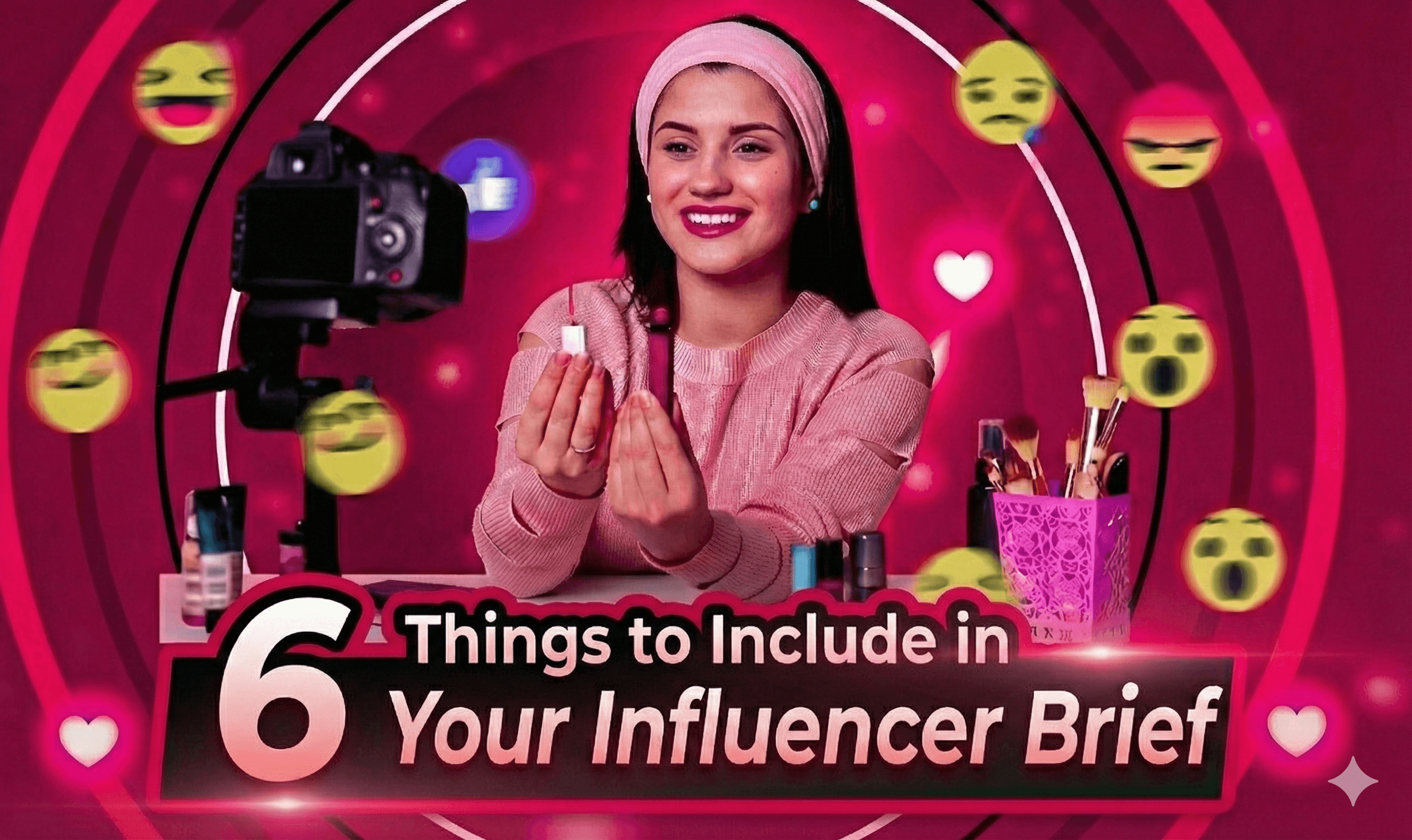

When your influencers campaigns aren’t working, you look at the dashboard and see weak views, low clicks, and zero conversions. The immediate reaction is to point fingers: “Wrong creator. Wrong audience. They just didn’t try hard enough.”
But usually, the creator isn’t the problem. The problem is that the brief was bad.
A brief is not a script. If you hand a creator a word-for-word script, you kill the authenticity that makes influencer marketing work. But if you give them no direction, you get content that rambles and doesn't convert.
A brief should act like a director coaching an actor, not a robot reading lines.

1. The "Elevator Pitch" Product Summary
If you can’t explain your product in two sentences, the creator won't be able to either.
Your brief must include:
The Name & Price: Basic facts.
The Benefit: What is new, better, or different?
The "Why": Why should the viewer care? What problem does it solve.
The Rule: If the summary is complicated and long, the video will be confusing. Confused viewers scroll away.
2. Don’t Bury the Lede
This is the single most common mistake in creator content. Left to their own devices, storytellers naturally want to save the "reveal" for the end. They want to build suspense.
In performance marketing, suspense is a conversion killer. Scrollers don’t stick around for a 30-second buildup.
Your brief needs to give explicit direction on timing:
Hook the viewer immediately.
Show the product early.
Name the product early.
You want the audience to know exactly what the solution is before their thumb hits the screen to swipe.
3. Define the Format, Not the Words
Creators aren't mind readers. While you shouldn't script their words, you must structure the video. Tell them exactly what kind of video you are buying.
Give them a clear mental model, such as:
The POV Demo: "Here is exactly how I use this."
The Problem/Solution: "I had acne, and then I used this."
The Comparison: "Why I stopped using [Competitor X]."
The Test: "I tried it so you don't have to."
Guidelines provide clarity; scripts kill vibes.
4. The "Voice" Requirement
This is where brands often ruin a campaign. They want the creator to sound like a corporate press release.
You hired the creator for their specific relationship with their audience. If you force them to use corporate jargon or stiff language, the content dies in the feed. The audience smells a fake ad instantly.
The Instruction: "Speak in your own voice. Use your own slang. Be you."
5. Visual "Non-Negotiables"
While the audio should be loose, the visuals need to be tight. A blurry video or a product hidden in the shadows hurts the brand image.
Set clear technical expectations:
Lighting: Must be bright and clear.
Angles: The label must be readable.
Presentation: Clean background, appropriate clothing.
Think of these as the "quality control" section of the brief.
6. The Macro vs. Micro Distinction
Not all influencers should be briefed the same way.
If you are working with a Macro Creator (huge following), an obvious "hard sell" ad will often fall flat. Their audience is there for entertainment, not shopping.
For Macros: Tailor the brief to their audience. Give them more freedom to weave the product into a story.
The Guardrail: Ensure the "hook" and the "value props" are still there, but let them cook.
The Bottom Line
A great brief balances control with freedom.
It gives the creator clarity on the "What" (the product) and the "Structure" (the format), but total freedom on the "How" (the personality).
When you give creators context, guardrails, and permission to be authentic, the content doesn't just look better—it actually performs.
Reference: Cherene Aubert shared a tweet. We loved it so much and developed it a bit more.