⬆️ Watch this video overview ⬆️

Every growing brand eventually hits a crossroads and asks the same question: “Should we bring our creative in-house?”
It’s not just about saving money
Too often, they ask for the wrong reasons. They think it’s about cutting agency fees or "looking more legit." But bringing creative internal isn’t a cost-saving measure. It’s a maturity move. If you do it too early, or without the right leadership, you won't just waste money; you’ll actively hurt your performance.
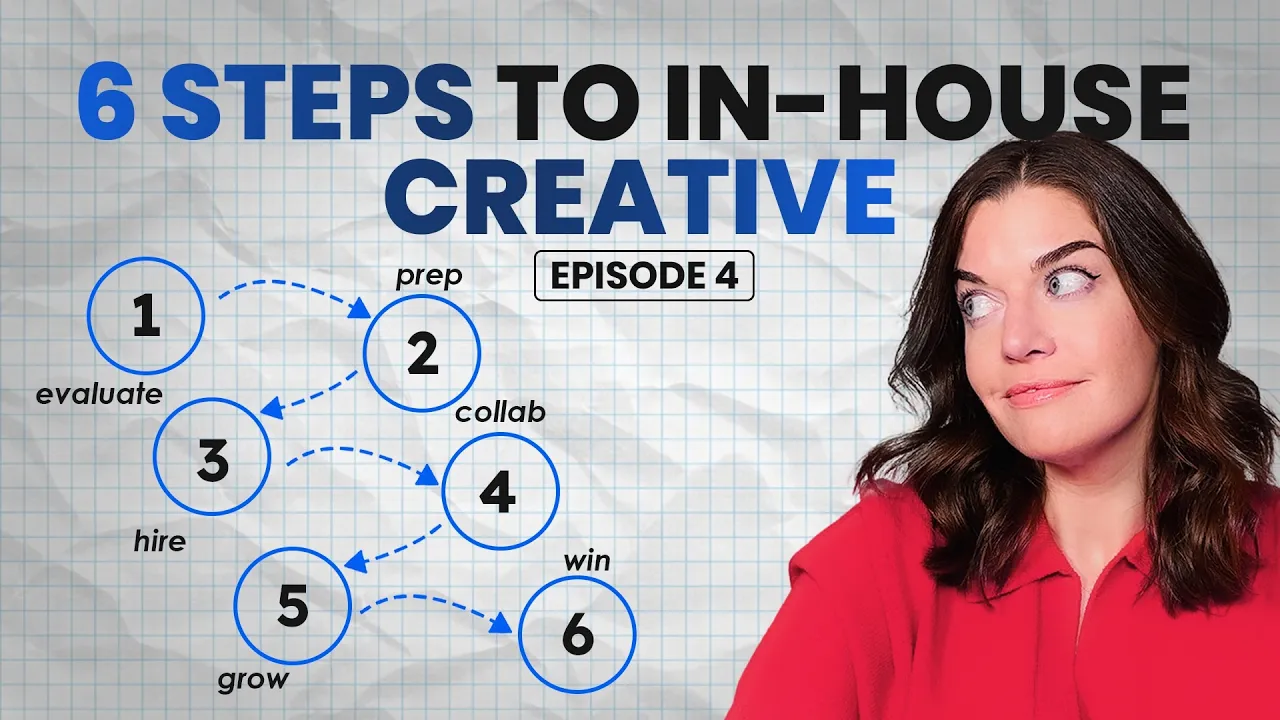
I’ve seen brands rush this and implode, and I’ve seen brands do it right and unlock an entirely new level of growth. Here is the 6-step framework for transitioning your creative from external agencies to an internal powerhouse.
Step 1: Evaluate If You’re Ready
Early-stage brands should almost always use agencies unless content is one of their competitive advantage. Agencies bring speed, external perspective, and "pattern recognition" from working across dozens of accounts. They know the "dirty little tricks" that work right now.
However, agencies have a ceiling. They will never:
Understand your brand at a gut level.
Be emotionally invested in long-term brand health.
Live with the downstream consequences of creative decisions.
The Signal: When your internal creative starts consistently outperforming your agency ads, or when you’re ready to "protect the house" and build a long-term identity, it’s time to move.
Step 2: Prepare The Groundwork
You can’t just hire a designer and hope for the best. To succeed, your future Creative Director needs a counterpart: a seasoned Head of Growth or Media Buyer. This role can even be a freelancer (if they are the right person). In-house creative works when Growth and Creative operate as peers. If one is constantly "explaining" things to the other, the system is broken. Before you hire, ensure you have:
A Shared Drive: Organize your footage, founder videos, and UGC. Don't make your new hire hunt through Slack threads for assets. Ensure all raw assets are accounted for and accessible. Avoid submitting finished ads with baked-in music or graphics that cannot be reversed. If any footage is currently on physical hard drives, please migrate it to the shared drive or Recharm immediately.
Performance Data: Have a record of what has worked (and what hasn't) ready for review on Day
Step 3: Reposition Your Agencies (Don't Fire Them)
The healthiest brands don't choose between an agency or an in-house team, they use both.
In-House Team: Owns the overarching strategy, brand voice, and high-fidelity, brand-defining work.
Agencies: Provide external perspective, trend visibility, and specialized execution (like fast-iteration "dirty" performance ads).
Agencies are external by nature; they react to the brand. Your internal team should be steering the ship, using the agency as an extension of their nervous system to stay fresh.
Step 4: Hire Top-Down (The Director is Non-Negotiable)
Your first hire must be a Director-level operator. Many brands try to save money by hiring a junior strategist first. This is a mistake. Without a leader, you’ll just go in circles and waste testing dollars.
The Requirements:
Willing to get dirty: They need to write scripts and review edits themselves before they start managing a massive, growing team.
Agency Experience: This is mandatory. Someone who has only worked in-house lacks the cross-brand visibility needed to stay competitive. They need a network they can lean on to see what’s working elsewhere. Ideally, they should be a part of multiple Slack groups, text chains, and shared spreadsheets for anything from sharing top-performing ads and talent to problem-solving account issues.
Step 5: Build a Lean, Senior Core
If you’re spending around $1M/month, don't rush into a massive headcount. Build in stages:
Stage 1: Support your Director with a freelancer budget immediately. Let them bring in people they trust (editors/strategists) to ship work while you figure out full-time roles. A good leader has a roster of talent ready to follow them wherever they are.
Stage 2: The Core Four. Ideally, you want a Senior Creative Strategist, an Internal Editor, a Designer, and a Production/Casting Lead. And they MUST have paid experience.
Note: Do not skip the Production Lead. Herding influencers and managing logistics will eat your strategists alive.
Step 6: Measure Success Beyond ROAS/CPA
How do you know it’s working? It’s not just the Shopify dashboard. You’ll see it in the workflow:
Planning over Reacting: You have quarterly plans, not weekly scrambles.
Sharper Brand Voice: You stop sounding like five different brands across different channels.
Frictionless Scaling: When a "winning" idea (like a specific hook or aesthetic) is discovered by the paid team, it immediately moves to email, hook, and organic content without a "game of telephone." I literally had a top static ad get turned into a billboard in Times Square. that's the power of good creative strategy
The Bottom Line
Bringing creative in-house is about ownership. Agencies give you perspective, but an internal team gives you depth. When you align your creative DNA with your growth goals, you don't just save on fees, you build an asset that compounds over time.